
2 languages
Count Basie and His Orchestra
From HitStory, the pop encyclopedia of School of Rock · Artist
Count Basie and His Orchestra · Count Basie arrived in Kansas City in 1927, played with Walter Page and Bennie Moten and, after Moten's death in 1935, started his own group. That nine-piece band, with Lester Young on tenor sax, Jo Jones on drums and Walter Page on bass, among others, brought the Kansas City jam session to the clubs: long improvised solos over riffs from the band. In 1936 the producer John Hammond heard the group on the radio. He had Basie expand it into a big band and brought him to New York.
Music and breakthrough
In January 1937 the orchestra made its first records for Decca. One O'Clock Jump from 1937 and Jumpin' at the Woodside from 1938 followed, which made the orchestra famous nationally and internationally. They were so-called head arrangements: not written out, but built from riffs that the musicians knew by heart. With the guitarist Freddie Green one of the best-known rhythm sections in big band history was complete, and the singer Jimmy Rushing brought the blues.
Influence
After a short break in the early 1950s Basie built a new orchestra, with arrangers such as Neal Hefti, Quincy Jones and Sammy Nestico. Albums such as The Atomic Mr. Basie from 1958 and April in Paris showed a tighter and fuller ensemble, in which the arrangements became more important than the soloists. The orchestra worked with Frank Sinatra, Ella Fitzgerald and Joe Williams, and has continued to exist since Basie's death in 1984.
Listening
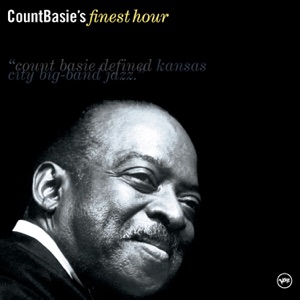 One O'Clock Jump · Count Basie and His Orchestra, 1937Apple Music ↗
Discography
Studio albums
- 1955Basie's Back in Town
- 1956April in Paris
- 1957Basie In London
- 1959Everyday I Have the Blues
- 1960Not Now, I’ll Tell You When
- 1961Swinging the Blues
- 1962On My Way & Shoutin' Again!
- 1962The Legend (From the Pen of Benny Carter)
- 1963Ella and Basie!
- 1964It Might as Well Be Swing
- 1966Basie's Beatle Bag
- 1966Broadway Basie's...Way
- 1966Hollywood… Basie’s Way
- 1967Basie's Beat
- 1967Basie's in the Bag
- 1968Straight Ahead
- 1969Basic Basie
- 1970Basie on The Beatles
- 1977Prime Time
- 1982A Classy Pair
- 1982Singin' Up A Storm
- 1984Kansas City Suite - The Music of Benny Carter
- 1985Basie in Europe
- 1985Have a Nice Day
- 1985I Told You So
- 1985On the Road
- 1989Flip, Flop & Fly
- 1989The Giants of Boogie Woogie
- 1989The Legend, the Legacy, the Count Basie Orchestra
- 1989Tony Bennett with the Count Basie Orchestra
- 1990Big Boss Band
- 1993Shoutin’ Blues
- 199488 Basie Street
- 1994Basie's Bag
- 1995En Concert, 1960/62
- 1996Jazzin'
- 1997At the Royal Roost 1948
- 1998At Long Last
- 1998Count Plays Duke
- 1998Send in the Clowns
- 1998Warm Breeze
- 1999Atomic Swing
- 1999Basie Big Band
- 1999Swing Shift
- 2000Fancy Pants
- 2001Shoutin' Blues
- 2001Swingin' at the Chatterbox 1937
- 2002Basie Meets Bond
- 2002Bon Basie de Paris
- 2004Basie's Beat
- 2005Basie Land
- 2006Jumpin' At The Woodside
- 2006On the Sunny Side of the Street
- 2006Ray Sings, Basie Swings
- 2008Mustermesse Basel 1956 Part 1
- 2009Swinging, Singing, Playing
- 2010Dance Along With Basie
- 2012A Beautiful Friendship
- 2013On My Way and Shoutin' Again! / Not Now, I'll Tell You When
- 2015A Very Swingin' Basie Christmas!
- 2016High Voltage
- 2016Straight Ahead
- 2017Jumpin' At The Woodside
- 2018All About That Basie
- 2023Basie Swings the Blues
- ?Basie In London
In School of Rock
The chapters, maps and magazine stories of School of Rock are currently available in Dutch only.
- After Hours: Session 1NL Reader