
2 languages
Virgil Thomson
From HitStory, the pop encyclopedia of School of Rock · Artist
Virgil Thomson was born in 1896 in Kansas City, Missouri, and was both a composer and a critic. He studied at Harvard, took an interest in the piano music of Erik Satie and lived in Paris from 1925 to 1940. There he studied with Nadia Boulanger and was influenced by members of Les Six. His most important friend was the writer Gertrude Stein. Together they made the opera Four Saints in Three Acts, performed in 1934 with an all-Black cast, and in 1947 The Mother of Us All. Thomson wove Baptist hymns, Gregorian chant and popular songs into his scores.
Music and breakthrough
In 1936 he wrote the music for the documentary The Plow That Broke the Plains by director Pare Lorentz, commissioned by the American government. He used folk melodies and religious themes and later also made an orchestral suite of it. In 1938 came the film The River, and for Louisiana Story he received the Pulitzer Prize for music in 1949. From 1940 to 1954 he wrote for the New York Herald Tribune. He supported younger composers such as Ned Rorem and John Cage. He died in 1989.
Influence
Thomson played a major role in the emergence of what is called the American sound in classical music: simple, clear and with an open-air quality. That sound later returned in film music and in a great deal of American pop.
Listening
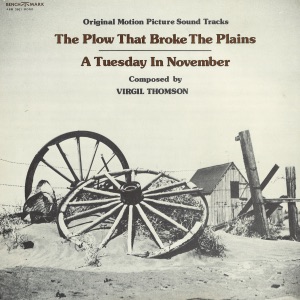 The Plow That Broke the Plains: Cattle · Virgil Thomson, 1936
Discography
Studio albums
- 1986Music for the Films, "The River" & "The Plow That Broke the Plains"
- 1989The River / The Plow That Broke the Plains
- 1991Early And As Remembered
- 1992American Miniatures
- 1992Four Saints in Three Acts
- 1992Great American Landscapes
- 1992Louisiana Story / The Plow that Broke the Plains
- 1992The Mother of Us All (The Santa Fe Opera feat. conductor: John Crosby)
- 1999American Flute Concertos
- 1999Symphony on a Hymn Tune / Symphony no. 2 in C major / Symphony no. 3 / Pilgrims and Pioneers
- 2000Sacred & Secular Choral Music
- 2001The Plow That Broke the Plains / The River
- 2005Four Songs to Poems of Thomas Campion / Violin Sonata / Praises And Prayers
- 2007The Plow That Broke the Plains / The River (soundtrack)
- 2008Jamestown Concerto: American Music for Cello and Orchestra
- 2008John Corigliano: The Red Violin / Caprices / Violin Sonata / Virgil Thomson: Three Portraits / Five Ladies / Eight Portraits
In School of Rock
The chapters, maps and magazine stories of School of Rock are currently available in Dutch only.
- The Dream Factory: Film Reel 2NL Reader
Mentioned in other articles
- Americana Genre
In 1936 Virgil Thomson wrote the music for The Plow That Broke the Plains, a government documentary about the Dust Bowl, with hymns, cowboy songs and simple harmonies.