
2 languages
Steve Reich
From HitStory, the pop encyclopedia of School of Rock · Artist
Steve Reich is an American composer who helped shape minimal music in the second half of the 1960s. He was born in New York in 1936, studied philosophy at Cornell University and then composition at Juilliard and Mills College, where Luciano Berio and Darius Milhaud were his teachers. His first breakthrough came with tape works. In It's Gonna Rain and Come Out he had two identical recordings of a spoken sentence slowly drift out of sync, so that a single sentence turned into a web of rhythms. This technique is called phase shifting.
Music and breakthrough
In 1970 Reich travelled to Ghana to study the polyrhythmic music of the Ewe for five weeks. Drumming, a large work for percussion, voices and flutes, grew out of that. Later he studied Balinese gamelan. Both experiences resonate in Music for 18 Musicians, which he began in 1974 and which is based on a cycle of eleven chords. The piece is written for a larger ensemble with marimbas, xylophones, pianos, strings, clarinets and voices. It breathes, pulses and changes so gradually that the listener only notices the shifts afterwards.
Influence
In the 1980s his work took on a darker tone, with Jewish themes in Tehillim and historical themes in Different Trains. Reich's repeating patterns have had an effect on experimental music, rock and contemporary electronic music. That explains why School of Rock mentions him on the road to minimalist thinking in pop music.
Listening
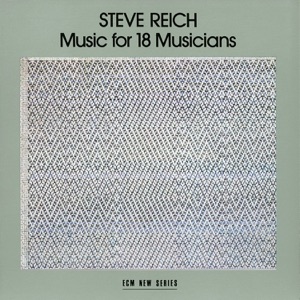 Music for 18 Musicians · Steve Reich, 1978Apple Music ↗
Discography
Studio albums
- 1970Four Organs / Phase Patterns
- 1973John Cage: Three Dances / Steve Reich: Four Organs
- 1974Drumming / Six Pianos / Music for Mallet Instruments, Voices and Organ
- 1978Music for 18 Musicians
- 1980Octet / Music for a Large Ensemble / Violin Phase
- 1982Tehillim
- 1983Reich: Music for Pieces of Wood / Rzewski: Coming Together / Attica / Szemző: Water-Wonder / Melis: Etude for Three Mirrors
- 1984Adams: Grand Pianola / Reich: Eight Lines
- 1985II.
- 1985John Adams: Grand Pianola / Steve Reich: Eight Lines / Vermont Counterpoint
- 1985The Desert Music
- 1986Sextet / Six Marimbas
- 1987Drumming
- 1987Early Works
- 1989Different Trains / Electric Counterpoint
- 1990Minimalist
- 1990Music for Mallet Instruments
- 1990Steve Reich: Six Pianos / Terry Riley: In C
- 1990The Four Sections / Music for Mallet Instruments, Voices and Organ
- 1991Electric Counterpoint
- 1993Another Look at Counterpoint
- 1993Atelier Schola Cantorum 5
- 1993Six Pianos / Variations / Music for Mallet Instruments
- 1993Volans: Kneeling Dance / Lang: Face So Pale / Reich: Four Organs / Moran: Three Dances
- 1994Tehillim / Three Movements
- 1995Music for Mallet Instruments
- 1995The Cave
- 1996City Life / Proverb
- 1996Jazz / Minimal / Avantgarde
- 1996The Desert Music / Shaker Loops
- 1998Music for 18 Musicians
- 1999American Clarinet
- 1999Exclusive Selection
- 1999Music for 18 Musicians
- 1999Phase Patterns / Pendulum Music / Piano Phase / Four Organs
- 2000New York Counterpoint / Eight Lines / Four Organs
- 2001Triple Quartet
- 2001Y Bolanzero
- 2002Angel Artistry: Cage: Three Dances / Reich: Four Organs / Stravinsky: Rite of Spring
- 2002Drumming
- 2002Ponder Nothing
- 2002Tehillim / The Desert Music
- 2002Variations
- 2003City Life / New York Counterpoint / Eight Lines / Violin Phase
- 2003Drumming
- 2003Three Tales (soundtrack)
- 2004Different Trains / Triple Quartet / The Four Sections
- 2005Different Trains
- 2005Drumming
- 2005Music 4 Hands
- 2005You Are (variations) / Cello Counterpoint
- 2006Reich at the Roxy
- 2006Reich: Different Trains / Piano Phase / Mellits: String Quartet no. 2
- 2006Soundscapes
- 2007Early American Minimalism / Walls of Sound II / Wallpatterns-Patternwalls
- 2007Music for 18 Musicians
- 2007Sextet / Piano Phase / Eight Lines
- 2008American Classics: Minimalism
- 2008Daniel Variations
- 2008Percussion Masterpieces
- 2010Double Sextet / 2x5
- 2010Reflections
- 2011American Music
- 2011Different Trains / Piano Counterpoint / Triple Quartet
- 2011Kuniko Plays Reich
- 2011Three Movements / The Desert Music
- 2011WTC 9/11 / Mallet Quartet / Dance Patterns
- 2012Steve Reich: Electric Counterpoint
- 2013Metamorphosis / Acoustic Counterpoint
- 2014Four Organs / Phase Patterns / Pendulum Music
- 2014Radio Rewrite
- 2015Music for 18 Musicians
- 2016Clapping Music / Music for Pieces of Wood / Sextet
- 2016Different Traces: Works for Saxophone Solo and Electronics
- 2016Double Sextet / Radio Rewrite
- 2016Duet
- 2016Joe Hisaishi Presents Music Future 2015
- 2016Six Pianos / Keyboard Study # 1
- 2016Steve Reich
- 2016The Minimalists
- 2016WTC 9/11 / Different Trains
- 2017Joe Hisaishi Presents Music Future II
- 2018Drumming
- 2018Drumming
- 2018Pulse / Quartet
- 2018Sextet / Double Sextet
- 2020Eight Lines / City Life
- 2020Music for 18 Musicians
- 2021Bach / Reich
- 2021Music for 18 Musicians
- 2021Steve Reich, Nexus, Sō Percussion
- 2022Reich/Richter
- 2022Runner / Music for Orchestra and Ensemble
- 2023Drumming
- 2023ICONS - The American Minimalists
- 2023Music for 18 Musicians
- 2023The String Quartets
- 2023What Remains
- 2024Kuniko Plays Reich II
- 2025Jacob’s Ladder / Traveler’s Prayer
- 2025Joe Hisaishi Conducts
- 2026Reich: Drumming; Music For Mallet Instruments, Voices and Organ; Six Pianos
- 2026The Sextets
In School of Rock
The chapters, maps and magazine stories of School of Rock are currently available in Dutch only.
- The Dream Factory: Film Reel 5NL Reader
Mentioned in other articles
- Minimal music Genre
Terry Riley wrote In C (1964), in It's Gonna Rain (1965) Steve Reich had two tape loops slowly drift out of step, and Philip Glass worked with repeated arpeggios; he and Riley were inspired by Indian music.