
2 languages
Arnold Schönberg
From HitStory, the pop encyclopedia of School of Rock · Artist
Arnold Schönberg · Arnold Schoenberg of Vienna began in the late Romantic style of Wagner and Mahler and around 1908 let go of the tonic altogether, which he called the emancipation of the dissonance. In Pierrot lunaire of 1912 the voice hovers between speaking and singing, a technique called Sprechstimme. Around 1923 he developed the twelve-tone method, in which all twelve tones in a fixed row are of equal standing. As a teacher in Vienna, Berlin and Los Angeles he shaped generations of composers.
Listening
Listening tip. Listen to Mondestrunken and hear how the singer half speaks and half sings the text, above a piano that keeps repeating the same glittering little figure.
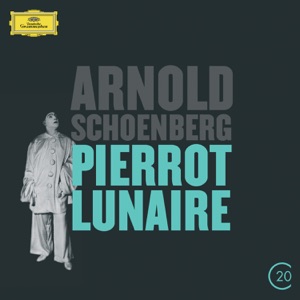 Pierrot lunaire: Mondestrunken (Christine Schäfer, Ensemble Intercontemporain, Pierre Boulez) · Arnold Schönberg, 1912
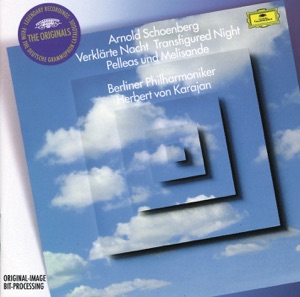 Verklärte Nacht: I. Grave (Berliner Philharmoniker, Herbert von Karajan) · Arnold Schönberg, 1899
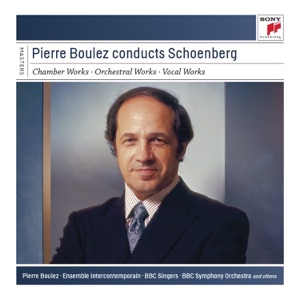 Fünf Orchesterstücke op. 16: III. Farben (BBC Symphony Orchestra, Pierre Boulez) · Arnold Schönberg, 1909
- Fünf Orchesterstücke op. 16: Farben (BBC Symphony Orchestra, Pierre Boulez) · Arnold Schönberg, 1909
In School of Rock
The chapters, maps and magazine stories of School of Rock are currently available in Dutch only.
- The Dream Factory: Film Reel 1NL Reader
- The Dream Factory: Film Reel 2NL Reader
Mentioned in other articles
- Modernism, atonality and avant-garde Genre
Leonard Rosenman, who had studied with Arnold Schönberg, wrote East of Eden (1955) and The Cobweb (1955).