 School of RockSchool of Rock
School of Rock · Mixtape 2
Rockers, mods, Indorockers, hippies, punks and skinheads, and the music that went with their clothes.
A sixteen-year-old boy in London in 1958 wore a long jacket with a velvet collar and a greased quiff. His younger brother, six years later, rode a scooter with ten mirrors, in a tailored suit under an army parka. Another ten years on, a boy from the same street had a mohican and a jacket covered in safety pins. All three belonged to a group, and every group had its own music.
That young people have a culture of their own seems obvious today. Yet it is an invention of the years after the Second World War. Only then did young people have enough money, time and freedom to deliberately set themselves apart from their parents, and only then was there an industry that wanted to help them do it. Clothes, haircut, language and music became a way of showing who you belonged with. That raises the question that keeps returning: why does a generation choose a sound of its own, and what makes that sound recognisable as "ours"?
The answer lies partly in fashion and politics, but largely in the music itself: in a slapback echo, a stuttering singer, a Hawaiian guitar, an open guitar tuning or an organ over a ska rhythm. If you listen closely, you can hear the group in it.
Side A · 1945-1965
Idols, prosperity and rock 'n' roll: how the teenager became a group of his own.
Track 01 · 1842-1870 · England and America
Anyone who thinks screaming fans began with Elvis or the Beatles has to look back a century further. In the nineteenth century the English writer Charles Dickens was the best-known author in the English-speaking world. His novels appeared in instalments in magazines, so readers had to wait months for the next part. Whole households read along, and the instalments passed from hand to hand.
Dickens was more than a writer. He was a performer. From 1858 he gave paid reading evenings, standing alone on a stage and playing his own characters with different voices and gestures. He toured England and America with these shows, a tour in the modern sense of the word.
Already on his first visit to America, in 1842, the crowds got out of hand. Fans tried to cut pieces from his fur coat as souvenirs. During his second American tour, in 1867 and 1868, people slept in the street at night, queuing for tickets. Anyone without a ticket bought one on the black market at many times the price. Dickens had a manager who arranged the travel and the ticket sales.
Tour, manager, fans, hysteria: everything that later goes with a pop star was already there a hundred years before Elvis. That shows what an idol needs. First of all a medium that carries him everywhere: for Dickens the magazines and the railways, later the radio, the television and the streaming service. Then an audience with time and money. And finally a person the audience can identify with. These three conditions keep returning in the rest of this chapter.
Track 02 · 1960-2022
Every decade has its own teen idol. If you listen to the fragments one after another, from Elvis Presley in 1960 to Harry Styles in 2022, you mostly hear differences: other instruments, another tempo, another production. But under those differences three things stay the same. There is a recognisable face. There is a simple hook, a phrase or melody that sticks after one hearing. And the production fits the medium of the moment exactly.
In 1960 Elvis Presley had just returned from military service in Germany. Are You Lonesome Tonight? is a waltz from 1926, with a spoken passage halfway through. The rebel of rock 'n' roll had become a crooner, a singer for the whole family. Three years later the Beatles sounded very different in Please Please Me: two-part vocals, a harmonica and a high "come on" as the hook. Mixtape 3 is about them.
With The Partridge Family, the idol was a product of television. The band was a family in an American TV series. Singer David Cassidy became a teen idol, but the music was played by studio musicians from Los Angeles, the Wrecking Crew. Fans bought a record by a band that did not really exist.
In the 1980s MTV became the most important medium. In Beat It (1983) Michael Jackson combined pop with hard rock: the guitar solo is by Eddie Van Halen. In Wake Me Up Before You Go-Go (1984) Wham! wrapped a Motown shuffle in a 1980s production. In Material Girl (1984) Madonna used a synthesizer bass and a drum machine, and determined her own image. The idol also became the director of his or her own image.
The 1990s brought the cast boy band and girl band. With Back for Good (1995) Take That sang a classic ballad with strings. In Wannabe (1996) the Spice Girls were five characters who together formed one brand. I Want It That Way (1999) by the Backstreet Boys was written by the Swedes Max Martin and Andreas Carlsson. In his way of working, the melody comes before the meaning of the lyrics: it sounds good, even if you do not know exactly what it is about. Mixtape 12 is about this way of making hits.
With Dynamite (2020) BTS brought Korean pop in English, with disco-funk as a retro sound: an idol for a worldwide audience that listens through streaming and social media. Harry Styles, once a member of the boy band One Direction, scored as a solo artist with As It Was (2022), a synth-pop track with a guitar riff at 174 bpm. Dickens's three conditions still apply. Only the medium has changed.
Track 03 · 1950-1960
After 1945 a period of great prosperity began in the United States. The factories that had made weapons during the war now produced cars, refrigerators and televisions. Families bought a house in the suburbs and a car to drive into the city. This is called the consumer society: a society in which buying is an important part of daily life.
Technology developed fast. In the 1950s television arrived in millions of American living rooms. Advertising became an industry. Two inventions were especially important for music. In 1949 the record company RCA Victor launched the 45 rpm single, a small, cheap record with one track on each side. In the mid-1950s came the transistor radio, small enough to take with you. A teenager could now listen to his own station in his own room, in the street or on the beach, out of his parents' reach.
In Western Europe the United States was the liberator and the ally. American culture became the example: Hollywood films, jeans, Coca-Cola, and the music that reached Europe over the radio and on the records of American soldiers.
At the same time the population changed. After the war many children were born in a short time, the baby boom. As a result, in the 1960s a large part of the population was young. These young people stayed in school longer than their parents, got pocket money or earned their own money with a part-time job, and had free time. The English word teenager only became common in the 1940s. For the first time there was a large group with money of its own but without the responsibilities of adults. For industry that was a new market.
Track 04 · 1954-1960 · United States
This new market was served by magazines for teenagers, by films and by the radio. Idols did not come only from music. Film actors such as Marlon Brando and James Dean became role models. In The Wild One (1953) Brando played the leader of a motorcycle gang, in a leather jacket and cap. In Rebel Without a Cause (1955) James Dean played a misunderstood teenager who clashes with his parents. Dean died in a car accident that same year, aged 24, and so remained the young rebel for ever.
Marketing and advertising sold a complete lifestyle: the clothes, the haircut, the film and the record belonged together. The radio DJ played a large part in this. DJs such as Alan Freed became stars themselves, because they decided which records the public heard. That also made them open to bribes. Record companies paid DJs and radio stations to play certain records. This is called payola. The scandal came out in 1959 and 1960. Alan Freed lost his career. Dick Clark, the presenter of the TV programme American Bandstand, got off with a slap on the wrist. The question of who pays to be heard is still with us, for example in the discussions about playlists on streaming services.
The first youth culture ran alongside white rock 'n' roll. Bill Haley & His Comets recorded Rock Around the Clock in 1954. The track only became a big hit when it was heard under the opening titles of Blackboard Jungle in 1955, a film about a teacher at a rough school in New York. In cinemas young people danced in the aisles, seats were wrecked and riots broke out in several places. For many adults that was proof that rock 'n' roll was dangerous. For the young it confirmed that this was their music.
Musically, Rock Around the Clock is less wild than its reputation. It is a 12-bar blues: a fixed pattern of twelve bars with three chords, which comes from Black blues music. Haley plays it with the line-up and the sound of a dance orchestra, with a saxophone and a double bass. Where that blues comes from and how rhythm and blues and country together became rock 'n' roll is described in Mixtape 1.
Track 05 · 1950-1960 · United Kingdom
A youth culture is a group of young people who set themselves apart through clothing, haircut, music and language. On the outside you show who you belong with, and so also who you do not. These groups came about because young people spent more time together: at school, at the cinema, in the café and in the street. Because they often received a better education than their parents, they also came into contact with new ideas about art, politics and freedom.
In England the first recognisable group was the Teddy Boys. They emerged in the early 1950s in the working-class districts of London. Their name comes from Edward, shortened to Teddy: they wore suits in the style of the age of King Edward VII, around 1900. A long jacket with a velvet collar, narrow trousers, a thin tie and shoes with thick soles. The hair was combed into a quiff with grease. It was expensive clothing for boys without much money: a way of showing that you spent your own money as you wished. When rock 'n' roll came over from America, the Teddy Boys became its first fans.
British artists began to imitate the Americans. Cliff Richard became the English answer to Elvis. His first single Move It (1958) is often seen as the first real British rock 'n' roll. With Living Doll (1959) he chose a tamer sound. The track has an acoustic shuffle, a skipping rhythm that comes from country, and soft, neat singing. It became a number 1 hit in England. His backing band, which soon afterwards became known as The Shadows, became famous in its own right with guitarist Hank Marvin and instrumental numbers.
This happened more often: the British took an American example and made something of their own from it. A few years later it would happen on a grand scale, when bands such as the Beatles and the Rolling Stones sent American rhythm and blues back to America.
Track 06 · 1955-1965 · England, United States, the Netherlands
In the mid-1950s the rockers emerged from the Teddy Boys. They went by various names. In England they were also called ton-up boys, after the 'ton', the hundred miles an hour they wanted to reach on their motorbikes, or café racers, after the roadside cafés where they gathered. In the United States they were called greasers, after the grease in their hair. In the Netherlands they were the nozems, and in Amsterdam the dijkers, after the Nieuwendijk.
The style was simple and tough: a motorbike, a leather jacket, jeans and hair combed back with Brylcreem. The example was Marlon Brando in The Wild One. The rockers came from the working class and often had a job at an early age. Their money went on the motorbike.
Their music was rock 'n' roll and rockabilly, the fast, bare variant in which country and rhythm and blues come together. You recognise this music by a few clear features. The vocals have a slapback echo: one short repeat, soon after the voice, which defined the sound of Sun Records in Memphis. The double bass is not only plucked but also slapped, so that the strings hit the neck and make a clicking rhythm. And the electric guitar has a sharp, metallic tone: the twang.
The idols of the rockers were Elvis Presley, Gene Vincent and Eddie Cochran. Gene Vincent became famous with Be-Bop-A-Lula (1956) and from his British period wore black leather on stage. Eddie Cochran was a skilled musician who often played the guitar and the bass himself in the studio. In C'mon Everybody (1958) he uses a stop-time riff: the band plays a short motif and then falls silent, and in that silence Cochran sings his line. As a result the voice gets all the attention.
Cochran and Vincent were even more popular in England than in America. In April 1960 they were on tour there together. On the way to London their taxi crashed. Cochran died, aged 21. Vincent was injured. For the British rockers Cochran afterwards became a hero, just as James Dean was for the American teenagers.
Side B · 1950-1966
Style as statement: scooters, Hawaiian guitar and bebop in smoky cafés.
Track 01 · 1958-1966 · London, Brighton
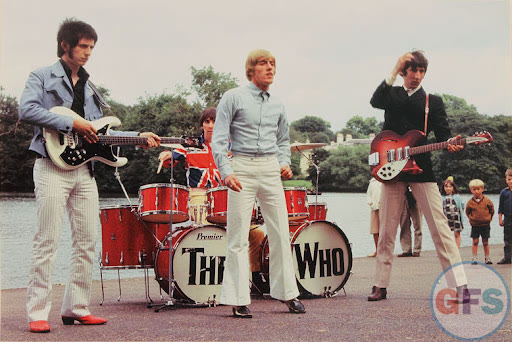
In the late 1950s a group emerged in London that looked very different from the rockers. The name mod comes from modernist: the first mods were fans of modern jazz. They too often came from the working class, but preferred to work in an office or a shop rather than in a factory. They spent their money on clothes. A mod wore a tailored suit with narrow lapels, a shirt with a button-down collar and pointed shoes. Mods were style-conscious down to the smallest detail.
They rode Italian scooters, a Vespa or a Lambretta, decorated with lots of mirrors and lamps. Over the suit they wore an army parka, so that the suit stayed clean on the road. Their music was at first modern jazz, then American soul and rhythm and blues, and ska from Jamaica. Later the British beat and psychedelic music were added. Mods danced all night in clubs in London.
Mods and rockers were each other's opposites: scooter against motorbike, suit against leather, soul against rock 'n' roll. In 1964 this rivalry got out of hand. During the spring holidays groups of mods and rockers headed for seaside resorts on the south coast, such as Brighton and Margate, and there fights broke out. The newspapers were full of it. The coverage made the groups bigger and better known than they were. The film Quadrophenia (1979), based on the album of the same name by The Who, is set in this period; the high point is the riots in Brighton.
The bands of the mods were The Who, the Small Faces and The Kinks. The Who consisted of singer Roger Daltrey, guitarist Pete Townshend, bass player John Entwistle and drummer Keith Moon. My Generation (1965) became their anthem. In the lyrics Daltrey sings that he hopes to die before he gets old. It became one of the best-known songs about the generation gap: a hit in which youth openly turns against its elders.
There is also a lot to hear musically. Daltrey stutters the lyrics, as if he is too excited or too angry to get his words out. John Entwistle plays short solos on the bass guitar, something unusual in 1965: the bass was mostly an accompanying instrument. The track modulates upwards three times, from G to A, to B♭ and to C. With every modulation the tension rises. This trick later became a pop cliché and got a mocking name in English: the truck driver's gear change, as if a lorry driver shifts up a gear. At the end Townshend lets his guitar ring round the amplifier. That feedback, really a technical fault, becomes music here. On stage Townshend regularly smashed his guitar.
Track 02 · 1957-1965 · the Netherlands, Germany
While in England mods and rockers faced each other, the Netherlands developed a form of rock 'n' roll of its own. After the independence of Indonesia in 1949, hundreds of thousands of Dutch-Indonesians and Moluccans came to the Netherlands. Among them were young musicians who had already heard American rock 'n' roll and country in the Indies, besides kroncong, an Indonesian style of music with string instruments, and Hawaiian music, which was very popular there.
Indorock was therefore more a subculture than a youth culture: it was the music of a community with its own roots, which had to start again in the Netherlands. The music was often instrumental. The guitarists played lightning-fast licks and used the Hawaiian guitar, a guitar that lies flat on the lap and is played with a metal bar over the strings. This lets notes slide and wail. A big show went with it: playing the guitar with your teeth, behind your head or lying on the floor.
The best-known group was The Tielman Brothers, a family band with Andy Tielman as singer and guitarist. They were already playing in German clubs from 1959, a year before the Beatles first came to play in Hamburg in 1960. The Tielman Brothers are therefore seen as pioneers of European rock. Indorock was the first Dutch pop music to conquer Germany: dozens of Dutch-Indonesian bands played in German clubs. In a TV recording of Bossa Nova Baby you can see what that meant. Andy Tielman plays fast runs, and the band delivers the show it was known for.
In the early 1960s Indorock slowly turned into Indopop: calmer, with more singing and more melody. The duo The Blue Diamonds, the brothers Riem and Ruud de Wolff, had a big hit in 1960 with Ramona, in Germany too. Their two-part vocals sounded soft and polished, a good deal tamer than the wild shows of the Tielmans. Mixtape 11 is about the further history of popular music from the Netherlands.
Track 03 · 1950-1965 · Amsterdam, Paris
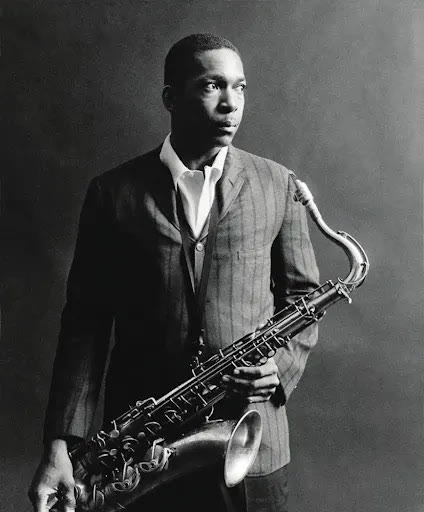
Not every youth culture revolved around rock 'n' roll. In the 1950s and early 1960s there was also a group of young people who were occupied with art, literature and philosophy. In Paris these were the existentialists, who sat in the cafés of the Saint-Germain-des-Prés district and discussed the ideas of the philosopher Jean-Paul Sartre. In Amsterdam they were called the Pleiners, after the Leidseplein, where they met in the cafés.
They wore black, often second-hand clothes and polo-neck jumpers. They watched films of the French nouvelle vague, in which young directors with small budgets and hand-held cameras broke the rules of Hollywood film. They were against authority and tradition and read writers such as Harry Mulisch, Simon Carmiggelt and Remco Campert, who could themselves also be found in the Amsterdam cafés.
Their music was modern jazz, and above all bebop. This style had emerged in New York in the 1940s, among musicians such as Charlie Parker and Dizzy Gillespie. Bebop has a fast tempo, quick chord changes and long, complicated solos. It is music to listen to, not to dance to. In this way the jazz musicians set themselves apart from the swing of the big dance orchestras, and the arty crowd from the entertainment music of their parents. Trumpeter Miles Davis and saxophonist John Coltrane were the heroes. The French part of the group also had the chanson, with singer Juliette Gréco as the face of Saint-Germain-des-Prés.
This group was smaller than the rockers or the mods, and less visible in the street. Yet its influence is great. The attitude of the arty crowd, critical, intellectual and against the establishment, returns in the 1960s with the hippies. More about bebop and modern jazz can be found in Mixtape 5.
Side C · 1965-1981
From flower power to no future: hippies, punks and 2 Tone.
Track 01 · 1965-1972 · San Francisco, Monterey, Woodstock
By the mid-1960s the baby boomers had grown up. Some of them turned away from the prosperity in which they had been raised. The hippies were against materialism, against the war in Vietnam and for peace, free love and a life closer to nature. Their motto became flower power. They wore long hair, beads and colourful, often home-made clothes. It was a broad movement, partly youth culture, partly subculture, with a centre in the Haight-Ashbury district of San Francisco.
This alternative culture is called the counterculture. Music played a leading part in it, as did experiments with drugs such as LSD, which changed the experience of music and colour. The summer of 1967 became the Summer of Love: tens of thousands of young people headed for San Francisco. In June of that year the Monterey Pop Festival took place, where Jimi Hendrix set his guitar on fire on stage. In August 1969 hundreds of thousands of people came to the Woodstock festival, on a farm in the state of New York. The festival became the symbol of an entire generation.
The music of the hippies was varied. There were singer-songwriters who sang personal and political songs with an acoustic guitar. There was folk rock, in which folk melodies were played with electric guitars. There was psychedelic rock, with long improvisations, reverb and distortion, which tried to imitate the experience of a drug trip. And there was raga rock, in which Western bands used Indian instruments and scales, such as the sitar that George Harrison played on Norwegian Wood (1965) by the Beatles. Well-known names are Grateful Dead, Jimi Hendrix, Crosby, Stills, Nash & Young, Joni Mitchell, the Beatles and Pink Floyd. Part of that rock music returns in Mixtape 4.
The Canadian Joni Mitchell is a good example of the singer-songwriter. In Big Yellow Taxi (1970) she sings that paradise has been paved to make a car park. It is one of the first pop songs about the environment. Yet the track sounds cheerful, with a skipping guitar and a little laugh at the end. Mitchell often tuned her guitar to an open tuning: the strings already sound together as a chord when you strum them open. In this way she found sounds and chords that are hard to play on an ordinarily tuned guitar. Mixtape 10 is about her role as a woman in pop music.
Mitchell also wrote Woodstock, a song about the festival, although she was not there herself. The track was made famous by others. Crosby, Stills, Nash & Young recorded a hard-hitting rock version of it in 1970. The British group Matthews Southern Comfort made a calm, gentle version of it in the same year. If you compare the two, you hear how one song gets a completely different atmosphere through tempo and arrangement.
Track 02 · 1975-1980 · London, New York
By the mid-1970s rock had become big, expensive and complicated. Prog rock bands played long numbers with virtuoso solos, in large halls, far from their audience. In the clubs, smooth disco was playing. In England the economy was bad and unemployment among young people was high. For a new generation the hippies' message of peace and love was no longer credible. They no longer had ideals, but anger.
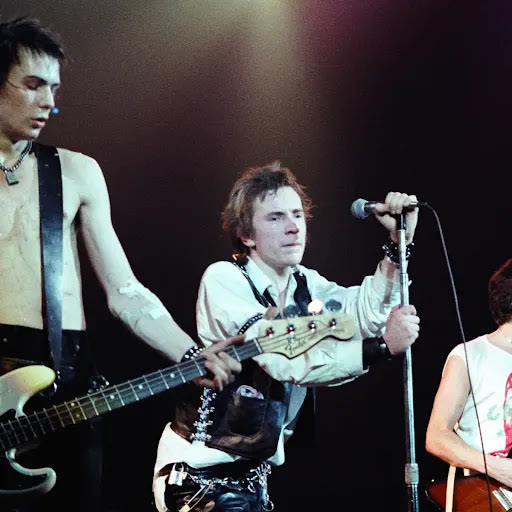
Punk was against every form of authority. The key idea was do it yourself: anyone can start a band, even if you can hardly play. The fashion was deliberately ugly and provocative: leather jackets, torn clothes, mohicans and safety pins. Part of that style came from SEX, the shop of designer Vivienne Westwood and Malcolm McLaren on the King's Road in London. McLaren also became the manager of the Sex Pistols.
The music was a reaction to prog rock: short, fast, loud and with few chords. No five-minute guitar solos, but songs of two to three minutes. Yet the picture of punks who could not play is only half true. On Anarchy in the UK (1976) by the Sex Pistols, guitarist Steve Jones recorded his parts several times over one another. This creates a wall of guitar sound. Above it singer Johnny Rotten sneers that he is an antichrist and an anarchist. In December 1976 the band members swore in a live TV interview. After that punk was national news, and in 1977 their single God Save the Queen was banned by the BBC.
Other bands were The Damned, The Stranglers and The Clash in London, and The Ramones in New York, where punk arose around the same time. The Ramones played short, fast songs at the club CBGB and were an example for the British bands.
Punk was also a way of producing. Bands recorded cheaply and released their records on small, independent labels such as Stiff and Rough Trade. Fans made fanzines: photocopied leaflets with interviews and reviews. That infrastructure of their own, outside the big record companies, became the basis of the later indie scene.
Track 03 · 1969-1981 · England
The word skinhead now often calls up images of far-right violence. But the first skinheads, around 1969, had nothing to do with that. They were neo-mods from the English working-class districts, who exchanged the refined style of the mods for something rougher: a shaved head, jeans, braces and Dr. Martens boots. It was the clothing of a working boy.
In those same working-class districts lived Jamaican migrants and their children. The Jamaican youths had their own street culture, the rude boys, and their own music: ska, rocksteady and reggae. Ska has a fast rhythm in which the guitar and the piano play between the beats each time, on the 'and': the offbeat. The skinheads adopted that music. In 1969 Desmond Dekker had a hit in England with Israelites, and a current arose that was called skinhead reggae.
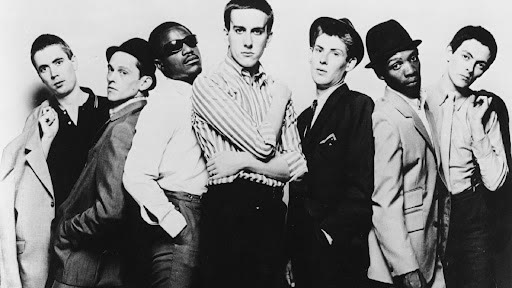
Only later, in the late 1970s, did the far right hijack the image of the skinheads. Groups such as the National Front looked for new members among unemployed young people. Resistance arose against this. In 1979 keyboard player Jerry Dammers founded the label 2 Tone in Coventry. The name refers to black and white together. The bands on the label were often deliberately mixed, with Black and white musicians, and played a new version of ska, faster and with the energy of punk. The best known were The Specials, The Selecter and The Beat, and the white band Madness also started on the label. Madness took its name from a song by the Jamaican ska singer Prince Buster.
Ghost Town (1981) by The Specials is the high point of 2 Tone. The track is about English towns emptying because of unemployment, in the time of Prime Minister Margaret Thatcher. The clubs are closed, the young have nothing to do and violence is growing. In the summer of 1981 the track was number 1 in the British chart, while riots broke out in several English cities.
Musically, Ghost Town is unusual for a hit. It is in a minor key, uses diminished chords and chromaticism, and the horns play a line that recalls Middle Eastern music. Underneath lies a slow ska and reggae rhythm with the offbeat. A ghostly organ and the howling of voices complete the picture of a deserted town. In this way the music tells the same story as the lyrics.
With 2 Tone this chapter comes full circle. The boys with the quiff, the scooter, the mohican and the shaved head each looked for a sound of their own. That sound was never completely new. It was an American example with a British accent, an Indonesian tradition with an electric guitar, or Jamaican ska with the anger of punk. What made it "ours" was the choice a group made from what already existed, and the way it wore, danced and defended that choice.
All the songs from this chapter, in the order of the text. Scan the code with your phone.
open.spotify.com/playlist/5DSSW1HM4g5zAx7HpwwXyz