 School of RockSchool of Rock
School of Rock · Mixtape 1
From work songs and ragtime to Rocket 88: the roots of everything that came after (up to 1955).
Anyone who writes a pop song today almost automatically uses a chord progression from the blues, a rhythm that stresses the second and fourth beat, a song form from the music publishers of New York and a line-up of guitar, bass and drums. All of these ingredients have an origin. They emerged between roughly 1880 and 1955 in the United States, and a large part of them in the South.
The people who made this music often had little say in what happened to it afterwards. Black musicians lived under segregation: they were not allowed to play in the same venues, were not played on the same radio stations and did not appear in the same charts as white artists. Yet their music became the foundation of what the whole world would later know as pop. That raises the question that keeps returning in this chapter: how did the music of the American South, made by people without rights, become the basis of worldwide pop music? For every style, three smaller questions help: who made the music, who earned money from it, and which musical feature travelled on to the next style?
Side A · 1933-now
Four definitions and one song that keeps changing hands.
The word pop seems simple. It is short for popular. But anyone who tries to say what pop music really is soon finds that several answers are possible. Take this working definition as a proposition: in pop, unlike in rock, what matters most is the song and the production, and less style and lyrical content. Is that true? The question is whether this sentence holds for a hit from 1920, 1955 and 2025, and whether it is not too simple. It is certainly not a watertight definition. Keep the proposition in the back of your mind: the question keeps coming back in this chapter.
Besides that working definition there are at least four ways of looking at pop. The first is the simplest: pop is what is popular. What many people buy, stream and know. That can be measured through charts, sales figures and streams, but it says nothing about what the music sounds like.
The second definition comes from the British musicologist Philip Tagg. In 1982 he set popular music next to two other kinds of music: folk music and art music. Folk music is made by amateurs and passed on orally. Art music is written down and performed by trained musicians. Popular music is the third kind: made by professionals, distributed through recordings and mass media, and sold on a market. By this classification the blues of Robert Johnson was originally folk music, which became popular music through the record.
The third definition sees pop as a product. Pop is then made and packaged from above by songwriters, producers and record companies. The song and the production matter more than the artist who sings it. The working definition above fits this view of pop best, and the other three much less. The fourth definition sees pop as a genre. From the 1960s onwards pop means: short songs of three to four minutes, a form with verse and chorus, a hook, the vocals at the centre and aimed at the radio. In that sense pop is the opposite of rock, which likes to call itself 'real' and 'authentic'. This contrast between pop and rock has been described at length by the British pop sociologist Simon Frith.
None of the four definitions covers everything. A song from Tin Pan Alley, the New York street full of music publishers that comes up later in this chapter, fits all four. The blues fits almost none of them. The first track of this mixtape shows why the difference matters.
Track 01 · 1933-now · Appalachia, New York, Newcastle
House of the Rising Sun is a traditional: a song with no known author. It tells of a house in New Orleans that brought someone misfortune. Nobody knows exactly when it came into being. The song was passed from singer to singer, and every performer adapted the melody, the words and the accompaniment a little. This passing on by word of mouth and constant reworking is called the folk process. Put six recordings from different periods side by side and you can hear that process at work.
The oldest known recording is by Clarence Ashley and Gwen Foster from 1933, under the title Rising Sun Blues. They are two white musicians from Appalachia, the mountain region in the east of the United States. You hear Ashley's voice and guitar and Foster's harmonica, in a free rhythm. The melody is modal: it does not yet follow a fixed chord progression, as in a lot of old folk music. In the 1940s Lead Belly sings the song, the Black singer and guitarist Huddie Ledbetter. He plays a twelve-string guitar and sings with the phrasing of the blues. In this way the song moves from the white to the Black tradition, and later back again.
In the 1950s and 1960s young white musicians in New York rediscovered old folk music. In Greenwich Village, a neighbourhood full of cafés and small stages, the folk revival began. The singer and guitarist Dave Van Ronk came up with a new arrangement of House of the Rising Sun there, with a descending bass line and a chord progression in a minor key. Almost everyone who played the song afterwards used that version. One of the young musicians who heard it from Van Ronk was Bob Dylan. He recorded the arrangement for his 1962 debut album, without asking first. Van Ronk had wanted to record it himself. Who, then, is the author of a traditional: whoever began the song, whoever made the arrangement, or whoever first put it on record?
That question became very concrete in 1964. The British band The Animals, from Newcastle, turned the song into an electric pop song. The guitar plays broken chords (Am, C, D, F) in 6/8, Alan Price's electric organ plays a solo, and Eric Burdon's vocals build to a climax. The track lasts well over four minutes, long for a single at the time, and still became a number 1 hit in Britain, and in a shortened version in the United States too. On the record the arrangement was credited to Alan Price alone. He therefore received the royalties, which led to years of quarrelling in the band.
The last version in this series comes from the British rock band Muse, who used the arrangement live in the 2000s as an instrumental intro to one of their own songs. Muse does not play the version of Ashley or Van Ronk, but that of The Animals. The 1964 arrangement has by now become the tradition itself.
In this way a single song shows the difference between two ways of thinking about music. In the folk tradition a song travels by word of mouth and gets a new arrangement with every performer. Nobody is the owner. With the record and copyright a version suddenly becomes property, and so money. That shift, from shared song to saleable product, is one of the cores of the birth of pop music. To understand where that music came from, we go back to the city the song is about.
Side B · 1890-1945
Blues, ragtime, jazz and swing: where African, European and Caribbean music meet.
Track 01 · before 1900 · Louisiana
New Orleans lies at the mouth of the Mississippi, in the state of Louisiana. For a long time the city was a French and then a Spanish possession. Louisiana only came into the hands of the United States in 1803. As a result, customs there differed from those in the rest of the country. One of those customs had great consequences for the music. On a square on the edge of the city, Congo Square, enslaved Africans were allowed to gather on Sundays to dance, sing and drum until well into the nineteenth century. Nowhere else in the United States was that permitted. African rhythms and song forms therefore survived longer and more openly in New Orleans than elsewhere.
In Louisiana, musical traditions came together that nowhere else lay so close to each other. On the plantations enslaved people sang work songs: songs that set the rhythm of the work. One singer sang a line, the group answered. That form is called call and response. Besides the work songs there were field hollers: the calling and singing of one person in the fields, with a free approach to pitch. In church spirituals and later gospel arose, religious songs in several voices.
Opposite stood European music. Brass bands played marches, with brass instruments, a tight 2/4 time and fixed forms. Scottish, Irish and French immigrants brought their own folk music and dances. From the Caribbean, above all Cuba, came rhythms such as the habanera, with a characteristic accent that falls just off the beat. The pianist Jelly Roll Morton, one of the first great jazz musicians from New Orleans, later called that Caribbean rhythm the Spanish tinge. Without that Spanish colour, he said, you would never get the right flavour in your jazz.
All these currents existed side by side and influenced each other. From that mixture, in the decades around 1900, three styles grew that would form the basis of pop music: blues, ragtime and jazz.
Track 02 · from c. 1890 · Mississippi Delta
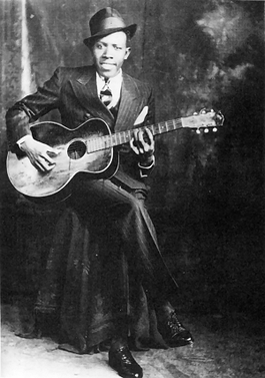
The blues grew around 1890 out of the work songs, hollers and spirituals of the Black population in the rural South. An important region was the Mississippi Delta, the fertile plain between the Mississippi and Yazoo rivers, where cotton was grown. Slavery had been abolished, but life remained hard. The blues sings about that life: about work, poverty, love, travel and misfortune.
Musically the blues has a number of clear features. The best known is the 12-bar blues: a fixed sequence of twelve bars over three chords, built on the first (I), fourth (IV) and fifth (V) degrees of the scale. A text in AAB form fits over it. The singer sings a line (A), repeats it (A) and then gives an answer (B). In this way the call and response of the work songs lives on in a single voice.
The second feature is the blue notes. These are notes that rub against the major scale: the minor third, the diminished fifth and the minor seventh, played or sung over a major chord. Blues musicians often sit just between two notes. On the guitar they bend a string upwards (a bend), and they use a rough, grating sound called dirty tone. The instruments were simple and portable: the voice, the guitar (often played with a tube or bottleneck over the strings, the slide guitar), the harmonica and, in the cities, the piano.
The best-known Delta blues musician is Robert Johnson (1911-1938). In 1936 and 1937 he recorded 29 songs in all and died a year later, aged 27. Little is known about his life, and so legends arose. According to the best known, he sold his soul to the devil at a crossroads in exchange for his guitar technique. In Cross Road Blues (1936) he sings about a crossroads, which fed the legend further.
Anyone who tries to count the bars of Cross Road Blues will find that the pattern does not add up. Johnson stretches a bar when he needs more room for the words, or moves to the next chord early. Delta blues musicians followed the lyrics, not a fixed pattern. The 12-bar form as a standard only arose later, mainly through recordings and through the electric Chicago blues after the Second World War, in which a whole band had to change chord at the same moment. Johnson's blues was rediscovered in the 1960s by British rock musicians: Eric Clapton played Cross Road Blues in 1968 with his band Cream as Crossroads.
Track 03 · c. 1895-1918
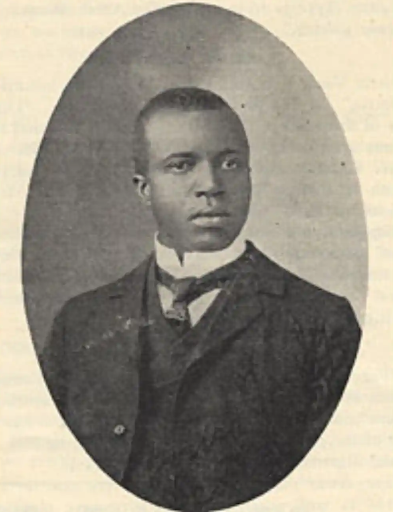
While the blues was passed on orally, an African American music was arising at the same time that was written down on paper: ragtime. It was the first African American style of music to be sold on a large scale as sheet music. Around 1900 many American living rooms had a piano, and ragtime was played at home from printed notes. That also made it one of the first forms of Black music on which a white public spent money on a large scale.
Ragtime is a bridge between two traditions. From European music come the notation, the form and the piano. From African American music comes syncopation: an accent between or before the beats. The division between the hands shows this well. The left hand plays a march bass: a low note on beats 1 and 3 and a chord on beats 2 and 4. That pattern is the forerunner of the stride piano of jazz. The right hand plays syncopations over it, against the beat. That 'ragged' rhythm gave the style its name: ragged time.
The form, too, comes from march music. A rag consists of strains: complete sections of sixteen bars, each with its own melody. A common order is AABBACCDD. The third section, the trio, is often in a different key, the subdominant. The time signature is 2/4, just like a march.
The most important ragtime composer was Scott Joplin. He lived for a time in Sedalia, Missouri, where his Maple Leaf Rag was published in 1899. That rag sold very well as sheet music. The Entertainer followed in 1902. Joplin saw ragtime as serious music and also wrote an opera, Treemonisha. He died in 1917, when interest in ragtime was already declining. The Entertainer only became world famous in 1973, when it was used as the theme music of the film The Sting.
Anyone who hears The Entertainer after Cross Road Blues hears two worlds. The blues is free, full of blue notes and follows the words. Ragtime is composed, tight in form and precisely notated. Both styles come together in the city where this chapter began.
Track 04 · c. 1900-1920 · New Orleans
Around 1900 the South of the United States was legally segregated. The Jim Crow laws, named after a caricature from the minstrel shows, kept Black and white people apart in schools, restaurants and trains, and kept Black citizens away from the elections. In music there was more room. Musicians could find work there, and in New Orleans they played in the streets, at parties, on riverboats and at funerals.
Those funerals, the jazz funerals, show well how different traditions came together in New Orleans. On the way to the cemetery a brass band played a slow hymn. On the way back the same band played a swinging version, and people walked along dancing. In this way the church, with its hymns and gospel, and the street, with its marches and blues, became connected. When the Saints Go Marching In is one of those hymns that the brass bands played in both ways.
From the brass bands grew the classic line-up of New Orleans jazz. In front stands the frontline with three wind players who each have their own task. The cornet or trumpet plays the melody. The clarinet plays a fast, embellishing counter-voice above it. The trombone plays a countermelody underneath and slides from note to note with glissandi. Behind them plays a rhythm section with banjo, tuba or double bass and drums.
The remarkable thing is that the three wind players improvise at the same time. Everyone knows the melody and the chord progression, and everyone fills in their own role freely. This is called collective improvisation. It sounds busy, but anyone who listens hears that the three lines rarely get in each other's way. That way of playing together became the sound of a new style.
Track 05 · c. 1897-1917 · Storyville
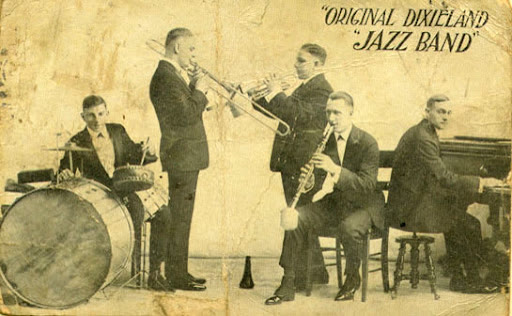
In 1897 the city council of New Orleans designated a district where prostitution was tolerated. The district was named Storyville, after the councillor Sidney Story, who had made the proposal. In the brothels, bars and dance halls of Storyville there was plenty of work for musicians. For Black musicians that was especially important: because of segregation they could not get into many other venues.
The music that sounded there was later called New Orleans jazz, also known as Dixieland or hot jazz. The word jazz was first written as jass. It was slang with a sexual charge. Where the word comes from exactly is still disputed. In the clubs of Storyville there was plenty of room to experiment. Bands played for hours for a dancing audience and could make a number last as long as they liked. Improvisation thus became a core value of the music.
Compared with the brass band, the jazz band was smaller, faster and looser. There was more room for solos: a musician who stepped forward and played a few rounds of the pattern alone. One of the boys who heard this music in the street was Louis Armstrong, born in 1901 in one of the poorest districts of New Orleans. As a child he sold coal, and meanwhile he listened to the bands. Later he became the trumpeter who put the solo at the centre of jazz. With his groups the Hot Five and Hot Seven he made records between 1925 and 1928 on which the emphasis shifts from collective improvisation to the virtuoso soloist. Jazz gets a chapter of its own in Mixtape 5 (Jazz Festival).
Track 06 · 1917
The year 1917 is a turning point. In March of that year the first jazz record appeared: Livery Stable Blues by the Original Dixieland Jass Band, recorded in February in New York. The musicians came from New Orleans, but they were white. The record sold well, and the band became famous as 'the inventors of jazz'. The Black musicians who had developed the style only made it onto record later.
That pattern is important for the rest of this chapter. Black musicians innovate, and a white band or artist provides the commercial breakthrough and earns the most from it. It happens again with swing and again with rock 'n' roll.
In April 1917 the United States entered the First World War. The most popular song of that moment was Over There by George M. Cohan, a cheerful marching song about the American soldiers who were about to go to Europe. It is not jazz, but a product of Tin Pan Alley, the music industry of New York. The rhythm is straight and tight like a march. Anyone who compares it with When the Saints Go Marching In hears what swing is, precisely because it is missing here. American soldiers and army bands did bring the new American music with them to Europe during the war years.
In New Orleans, too, much changed. In November 1917 Storyville was closed at the insistence of the American navy, which had a naval base in the city and wanted to keep its sailors out of the district. Many musicians lost their work and moved north, to Chicago and New York. They were not the only ones. Between 1910 and 1970 millions of Black Americans moved from the South to the industrial cities of the North, in search of work and away from the Jim Crow laws. That mass movement is called the Great Migration. The migrants took their music with them. In the 1920s Chicago became the new capital of jazz, and after the Second World War of electric blues.
Track 07 · c. 1930-1945 · New York, Kansas City
In the 1930s jazz became the popular dance music of the whole of America. The small New Orleans band grew into the big band, with twelve to seventeen musicians. Such an orchestra is divided into sections: saxophones, trumpets, trombones and a rhythm section with piano, guitar, double bass and drums. With so many musicians collective improvisation no longer works. That is why the arranger was given a central role. Arrangers such as Fletcher Henderson and Don Redman wrote short, repeated motifs, riffs, and had the sections answer each other: the saxes play a phrase, the brass answers. The call and response of the work songs echoes here, now between groups of wind players.
The rhythm changed too. In swing the eighth notes are played unevenly, long-short: the swing eighths. The bass no longer plays a march bass on 1 and 3, but walks evenly on all four beats, the walking bass. The guitar replaced the banjo in the rhythm section. The result is a rhythm that runs more smoothly and lightly than the jazz of New Orleans, and that is easy to dance to.
The great Black orchestras led the way. From the late 1920s Duke Ellington led the house orchestra of the Cotton Club in Harlem, New York. Count Basie came with his orchestra from Kansas City, where a sturdy, bluesy form of swing was played. Take the "A" Train (1941) became the signature tune of Ellington's orchestra. The piece was written by Billy Strayhorn, Ellington's regular co-composer, and refers to the subway line that ran to Harlem. The form is AABA: a melody that sounds twice, a contrasting middle section (the bridge) and then the first melody again. That form comes from Tin Pan Alley and returns later in this chapter.
Yet it was not a Black bandleader who became the 'King of Swing', but the white clarinettist Benny Goodman. His arrangements came largely from Fletcher Henderson, the Black bandleader who had helped devise the big-band style. At the same time Goodman was one of the first to put a mixed band on stage. From 1936 the Black musicians Teddy Wilson (piano) and Lionel Hampton (vibraphone) played in his small groups. In 1938 Goodman gave a concert in Carnegie Hall, the most famous concert hall in New York. Jazz had left the dance hall and reached the concert hall.
Swing was dance music for a mass audience, spread through the radio, records and dance orchestras that toured the whole country. With publishers, record companies, radio stations and well-known stars, a real pop music industry had arisen here for the first time.
Louis Armstrong summed up that development mockingly. According to him it was always the same music: first it was called syncopation, then ragtime, then blues, then jazz and now swing. Only the label changed, and who made money from it. That raises a question that returns with every style in this book: is a genre a musical category, or a commercial one?
Side C · 1885-1959
The white traditions, the music industry, and the collision that changes everything.
Track 01 · before 1920 · Appalachia
White immigrants, too, brought music to America. Immigrants from Scotland, England and Ireland settled in the Appalachians, the mountainous region in the east of the United States, from the eighteenth century onwards. They brought their songs and dances with them. There were ballads, long narrative songs about hard life, about love, murder and misfortune. And there was dance music, to forget that hard life for a while.
That dance music had fixed rhythms. The jig is in 6/8: two heavy beats per bar, each divided into three. The reel is in 4/4 or 2/2 and runs in even, fast notes. The most important instrument was the fiddle, the violin as played in folk music. The banjo sounded alongside it, and later the guitar and the accordion were added. All this music together got the collective name Appalachian music or mountain music.
The banjo shows that this white tradition was not separate from the Black one. The instrument is African American in origin, derived from West African lutes. It ended up in white music through the minstrel shows of the nineteenth century: performances in which white performers with blackened faces (blackface) ridiculed Black Americans. That is a painful origin, but one that shows how intertwined the traditions were.
Country and blues were never as separate as the record industry later made them seem. In the 1920s record companies sold music in two separate catalogues. Music by Black artists was called race records, music by white artists from the South was called hillbilly records. In reality Black and white musicians in the countryside often played the same songs, on the same instruments. The distinction said more about the market and about segregation than about the music.
Track 02 · 1920-1950 · Nashville
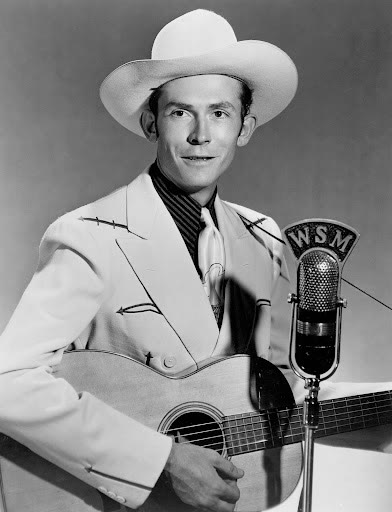
In the 1920s mountain music became country. Two technologies made that possible: the radio and the gramophone record. In 1927 the producer Ralph Peer made a series of recordings in Bristol, on the border of Tennessee and Virginia, which are often seen as the beginning of commercial country. The Carter Family and Jimmie Rodgers, who became the first stars of the genre, took part. As early as 1925 the radio programme that would later be called the Grand Ole Opry had begun in Nashville, Tennessee. The programme still exists and made Nashville the capital of country.
From the 1940s a new, fast variant arose: bluegrass. The name comes from the band of Bill Monroe, the Blue Grass Boys. Monroe came from Kentucky, the 'Blue Grass State'. He played mandolin and sang high and sharp. In 1945 the banjo player Earl Scruggs from North Carolina joined his band. Scruggs played with three fingers, in fast patterns of eight notes per bar, the rolls. That three-finger technique became the standard for the bluegrass banjo.
Scruggs and the singer-guitarist Lester Flatt left Monroe in 1948 and started a band of their own. Their instrumental Foggy Mountain Breakdown from 1949 became one of the best-known bluegrass pieces. It was used in 1967 in the film Bonnie and Clyde.
The most important country singer of this period was Hank Williams. He wrote songs about loneliness, drink and heartbreak, with simple lyrics that everyone understood. In doing so he became the blueprint for the country singer-songwriter. Williams died on 1 January 1953, not yet thirty years old.
His breakthrough came in 1949 with Lovesick Blues. That song shows well how mixed country already was. It is not a folk song from the mountains, but a Tin Pan Alley song from 1922. Williams sings it with a yodel, a technique that had become popular in country through Jimmie Rodgers. And in the accompaniment there is a blues break. Three traditions in one record: the New York music industry, white country and Black blues.
Track 03 · c. 1885-1950 · New York
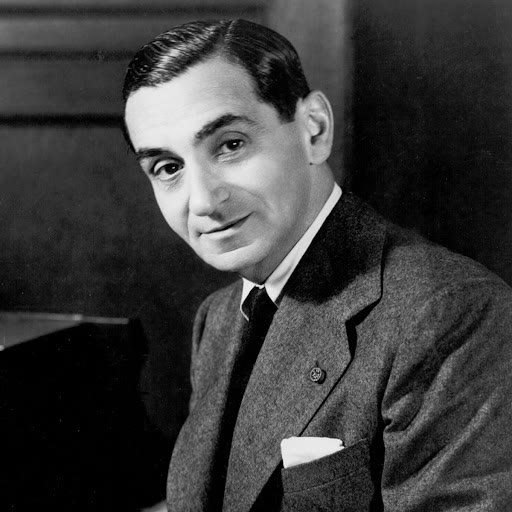
While blues, jazz and country were arising in the South, the song became a product in New York. From about 1885 more and more music publishers settled together in Manhattan, from the 1890s mainly on West 28th Street. From the open windows came the sound all day of pianos on which new songs were being tried out. According to a well-known story it sounded like the rattling of tin pans, and so the street got the name Tin Pan Alley.
Tin Pan Alley worked like an assembly line. Songwriters wrote songs, publishers printed them as sheet music and so-called song pluggers played them in department stores and theatres, so that the public would buy them. The money came from the sale of sheet music and from copyright. In 1914 ASCAP was founded, an organisation that collected money for composers and publishers when their songs were performed. Tin Pan Alley used all the styles that were popular, from ragtime to jazz and blues, but smoothed them out for a wide audience.
From the 1920s the standard Tin Pan Alley song had a fixed form: the 32-bar song in AABA form. A melody of eight bars (A) sounds twice, then comes a contrasting bridge (B) and finally A again. That form is easy to remember and to repeat, and it stayed in use for a long time. Many jazz standards are AABA, and even the Beatles still wrote songs in that form, such as Yesterday (see Mixtape 3).
The big names of Tin Pan Alley were Irving Berlin, George Gershwin, Cole Porter and the duo Rodgers & Hammerstein. Irving Berlin had his first big hit in 1911 with Alexander's Ragtime Band. He could hardly read music himself and played the piano only in F-sharp major, on the black keys. To play in other keys he used a transposing piano, whose keyboard you could shift with a lever. Even so he wrote hundreds of songs. His White Christmas was sung in 1942 by Bing Crosby in the film Holiday Inn and is regarded as the best-selling single ever.
Crosby also shows how technology changed the music. Before the microphone a singer had to sing hard and loud to reach a hall. With a microphone a singer could sing softly and close, as if standing next to the listener. That style of singing is called crooning, and Crosby was its best-known representative.
Tin Pan Alley is the invention of pop as a product. The song stands apart from the performer and can be sung by anyone. Here the working definition from the beginning of this chapter seems to fit well: it is all about the song and the production. With the blues, which you heard earlier in this chapter, that same definition jars. The model of songwriters and publishers in one building or street lived on in the pop industry of later years. Mixtape 12 (The hit factory) is about that.
Track 04 · 1947-1954 · Memphis
After the Second World War big bands had become too expensive to tour with. A smaller line-up with piano, guitar, bass, drums and one or two saxophones could make just as much noise, certainly with electric amplification. In Black music rhythm and blues arose in this way: loud, danceable music for an urban audience. Rock 'n' roll grew out of it, with influences from jump blues, boogie-woogie, gospel and country.
Two musical features make rock 'n' roll recognisable. The first is the backbeat: the stress on beats 2 and 4, played loudly on the snare drum. In the march and in ragtime the weight lay on 1 and 3. Now it shifts to the beats in between, and that gives the music its driving character. The second feature is the guitar riff with a recognisable motif: the hook, a short piece of music that stays in your head.
The pioneers of rock 'n' roll were Black. Sister Rosetta Tharpe was already playing gospel on an electric guitar in the 1940s, with a backbeat. Her Strange Things Happening Every Day, recorded in 1944, is often mentioned as one of the earliest examples of rock 'n' roll. You can read more about her in Mixtape 10 (Women in pop music). Fats Domino from New Orleans, Chuck Berry, Little Richard and Bo Diddley made the songs in the 1950s that would define the style.
A record that is often called the first rock 'n' roll record is Rocket 88 from 1951. The label says Jackie Brenston & his Delta Cats, but the band was actually Ike Turner's Kings of Rhythm. They recorded the song in Memphis, with Sam Phillips, who would discover Elvis Presley a few years later. On the way to the studio the guitar amplifier had been damaged. The guitarist stuffed the broken speaker with paper, and as a result the guitar sounded distorted and rough. That sound, which was really an accident, was later deliberately imitated.
Whether Rocket 88 really is the first rock 'n' roll record is a discussion without a winner. Sister Rosetta Tharpe had been playing electric guitar with a backbeat years earlier, and in the rhythm and blues of the late 1940s there are many candidates. Rock 'n' roll has no date of birth. It is the moment at which the lines of this chapter come together: the blues, swing, gospel and country.
Track 05 · 1954-1959
In the early 1950s a few technical and social changes came together. The first were technical. The solid-body electric guitar, such as the Fender that Leo Fender built in series from 1950, could be played loudly without feedback. Amplifiers and microphones became better. And the 45 rpm single, introduced by RCA in 1949, was small, sturdy and cheap. The second change was prosperity. After the war the United States was doing well economically. White teenagers had pocket money for the first time, a radio of their own and a record player. They formed a new market, with a taste of its own. Mixtape 2 (Youth cultures 1950-1980) is about that youth culture.
The disc jockey Alan Freed played a key role in this. From 1951 in Cleveland he played rhythm and blues by Black artists for a mixed and increasingly white audience. He made the term rock and roll popular, which had been in use in Black music for some time. In this way white young people heard music that could not be heard on most white stations.
The music industry reacted as it had in 1917 and with swing. White artists recorded covers of Black hits, and scored higher in the charts with them. In 1955 and 1956 Pat Boone recorded tame versions of Fats Domino's Ain't That a Shame and Little Richard's Tutti Frutti. He earned more from them than the original artists. Many Black pioneers had sold their rights or were paid little. White radio stations, venues and charts meanwhile remained largely segregated.
The song that brought rock 'n' roll to the general public was Rock Around the Clock by Bill Haley & His Comets. It was recorded in 1954 and only took off when it was used in 1955 in the film Blackboard Jungle, about rebellious young people at a school in New York. After that it stood at number 1 in the United States for weeks. Anyone who listens closely hears a 12-bar blues beneath the packaging of a white country band.
Other white musicians also made rock 'n' roll, such as Buddy Holly and Elvis Presley. In 1954 Presley recorded his first single with Sam Phillips in Memphis: That's All Right, a blues by the Black singer Arthur Crudup. On the B-side was a bluegrass song by Bill Monroe, Blue Moon of Kentucky, in a fast version. Black blues and white country on one single: in this way rock 'n' roll was also musically a meeting. You hear the same with Chuck Berry, whose Maybellene (1955) is based on the old country fiddle tune Ida Red.
A commonly heard misconception is that Elvis invented rock 'n' roll. He made the music known to a white audience, and with that worldwide. But the music he sang already existed: in the blues of the Delta, the gospel of Sister Rosetta Tharpe, the rhythm and blues of Memphis and the country of Nashville. Louis Armstrong had said it in the 1930s: the label changes, and who earns from it. How the music of the South became the basis of worldwide pop music is therefore also a story about who got the recognition and the money. The story continues in Mixtape 2, where rock 'n' roll becomes the music of a new generation.
All the songs from this chapter, in the order of the text. Scan the code with your phone.
open.spotify.com/playlist/7N2uEAg6SMOE3nLWw7wFv3