
2 languages
Morton Feldman
From HitStory, the pop encyclopedia of School of Rock · Artist
Morton Feldman was born in 1926 in Woodside, Queens, in New York, to Russian-Jewish parents. He had piano lessons and studied composition with Wallingford Riegger and Stefan Wolpe. In 1950 he heard the New York Philharmonic play Webern's Symphony and walked out in protest at the audience's indifferent reaction. In the foyer he met John Cage, with whom he became friends and went to live in the same building. Through Cage he got to know visual artists and writers, such as Jackson Pollock, Philip Guston, Robert Rauschenberg and Frank O'Hara.
Music and breakthrough
With Cage's encouragement, Feldman wrote music unconnected with tonal harmony or serialism. He used notation systems of his own, often grids, which indicated how many notes sounded at a given moment, but not which ones. His experiments with notation and chance inspired Cage to pieces such as Music of Changes. Feldman was one of the most important figures of the New York School. His music is soft, slow and floating, with rhythms that seem free and sounds that remain slightly blurred. After 1977 he also wrote very long pieces.
Influence
He was inspired by abstract expressionism. In 1971 he wrote Rothko Chapel, for the building with paintings by Mark Rothko, and in 1973 For Frank O'Hara. In 1977 he wrote the opera Neither to a text by Samuel Beckett. In this way he showed that music, like painting, can limit itself to a few colours and to stillness.
Listening
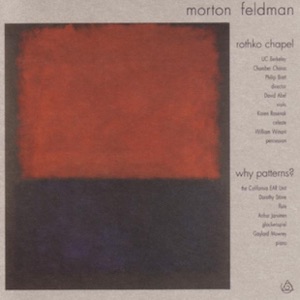 Rothko Chapel: vijfde deel (Karen Rosenak, David Abel e.a.) · Morton Feldman, 1971
Discography
Studio albums
- 1971The Viola in My Life / False Relationships and the Extended Ending
- 1981Feldman: Spring of Chosroes / Schnabel: Sonata for Violin and Piano
- 1989Three Voices (for Joan La Barbara)
- 1989Triadic Memories
- 1990For John Cage
- 1990Triadic Memories
- 1990Works for Piano
- 1991For Samuel Beckett
- 1991Pieces for More Than Two Hands
- 1991Rothko Chapel / Why Patterns?
- 1991Triadic Memories
- 1991Untitled Composition for Cello and Piano
- 1991Why Patterns? / Crippled Symmetry
- 1992For Christian Wolff
- 1992For Philip Guston
- 1992For Samuel Beckett
- 1993For Bunita Marcus
- 1993For John Cage
- 1993Piano and String Quartet
- 1993Piano and Strings Quartet
- 1993Triadic Memories
- 1994Crippled Symmetry
- 1994Morton Feldman
- 1994String Quartet
- 1994Winkler: Emergent / Feldman: The Rothko Chapel / Varèse: Intégrales / Octandre
- 1994Works for Piano 2
- 1995Brant / Scelsi / Wolpe / Xenakis / Cage / Glass / Feldman
- 1995Clarinet and String Quartet
- 1995For Bunita Marcus
- 1995New York School 3
- 1995Patterns in a Chromatic Field
- 1995Piano, Violin, Viola, Cello
- 1996Aki Takahashi Plays Morton Feldman
- 1996For Franz Kline / For Frank O'Hara / De Kooning / Piano Piece to Philip Guston
- 1996Only: Works for Voice and Instruments
- 1996Trio
- 1997Durations I-V / Coptic Light
- 1997For Philip Guston
- 1997Neither
- 1997Piano and Orchestra / Flute and Orchestra / Oboe and Orchestra / Cello and Orchestra
- 1997Trio
- 1998Coptic Light
- 1999All Piano
- 1999Crippled Symmetry
- 1999For John Cage
- 1999For Samuel Beckett
- 2000Atlantis
- 2000Complete Music for Violin & Piano
- 2000For Philip Guston
- 2000For Stefan Wolpe: Choral Music of Morton Feldman and Stefan Wolpe
- 2000Neither
- 2000Orchestral Works & Chamber Music
- 2000Piano
- 2000Routine Investigations / The Viola in My Life I, II / For Frank O'Hara / I Met Heine on the Rue Fürstenburg
- 2001Felder: In Between / Coleccion nocturna / Feldman: Instruments II / The Viola in My Life IV
- 2001Four Generations
- 2001Indeterminate Music: The Straits of Magellan / Projections / Durations / Two Pieces
- 2001Last Pieces
- 2001Piano and Orchestra / Palais de Mari / Piano
- 2001Piano and String Quartet
- 2001String Quartet (II)
- 2001Turfan Fragments
- 2001Violin and String Quartet
- 2002Complete Works for Two Pianists
- 2002Something Wild: Music for Film
- 2002String Quartet no. 2
- 2002The Rothko Chapel / For Stephan Wolpe / Christian Wolff in Cambridge
- 2002Violin & String Quartet
- 2002Voices & Instruments
- 2003Complete Violin|Viola and Piano Works
- 2003Early and Unknown Piano Works
- 2003Early Piano Works
- 2003Late Works With Clarinet
- 2003Palais de Mari / Three Dances / Nature Pieces / Intermissions I-VI
- 2003Three Voices
- 2004Patterns in a Chromatic Field
- 2004The Ecstasy of the Moment
- 2004The New York School: Nine Realizations of Cage, Feldman, Brown
- 2004Triadic Memories
- 2004Violin and Orchestra / Coptic Light
- 2005Composing by Numbers: The Graphic Scores 1950-67
- 2005Triadic Memories
- 2006Three Voices
- 2007Berio / Feldman
- 2007For Bunita Marcus
- 2007For Bunita Marcus / Palais de Mari
- 2007John Cage: Music for Keyboard 1935-1948 / Morton Feldman: The Early Years
- 2007String Quartet
- 2008Feldman: Triadic Memories / Skempton: Notti stellate a Vagli
- 2008For Christian Wolff
- 2008For Philip Guston
- 2008Strings, Keyboards, Percussion, Voices, Horn
- 2008The Viola in My Life
- 2009Clarinet Quintets
- 2009In a Silent Way
- 2009Music for Piano and Strings
- 2009Patterns in a Chromatic Field
- 2009Phantasy of Spring
- 2009Rothko Chapel
- 2009The Late Piano Works, Vol. 3: Piano / Palais de Mari
- 2009Trio
- 2011(Last Composition) Piano, Violin, Viola, Cello (28 May 1987)
- 2011Orchestra
- 2011Triadic Memories 2010 Version
- 2011Varèse: Amériques / Feldman: Piece for Four Pianos / Five Pianos
- 2012Piano and String Quartet
- 2012Violin & Piano
- 2013For Bunita Marcus
- 2013Rothko Chapel / For Frank O’Hara / The King of Denmark
- 2013Violin and Orchestra
- 2013Webern, Wolpe & Feldman
- 2014String Quartet no. 1 / Structures / Three Pieces
- 2014Two Pianos and Other Pieces, 1953-1969
- 2015American Masterpieces for Percussion, Vol. II
- 2015Clarinet and String Quartet
- 2015Ivan Ilić plays Morton Feldman
- 2015Piano, Violin, Viola, Cello
- 2015Radio Happenings: Conversations / Gespräche 1966-1967
- 2015Rothko Chapel
- 2016Beckett Material
- 2016Feldman: Palais de Mari / Intermission 5 / Piano Piece 1952 / Extensions 3 / Crumb: Processional / A Little Suite for Christmas
- 2017For Bunita Marcus
- 2017For John Cage
- 2017Piano, Violin, Viola, Cello
- 2018For John Cage
- 2019Chamber Music
- 2019For Bunita Marcus
- 2019Morton Feldman Piano
- 2019Patterns in a chromatic field
- 2019Piano
- 2020Coptic Light / String Quartet and Orchestra
- 2020For John Cage
- 2021Late Works for Piano
- 2021Piano and String Quartet
- 2022Le monde selon George Antheil
- 2023Violin and String Quartet
- 2024Complete Music for Cello & Piano
- 2024Piano, Violin, Viola, Cello
- 2025Intermission 6
- 2025The Viola in My Life
- 2026In Darkness and Light
- ?For Samuel Beckett