
2 languages
Ernst Busch
From HitStory, the pop encyclopedia of School of Rock · Artist
Ernst Busch was a German singer and actor, born in Kiel in 1900 into a working-class family. He first worked in a shipyard before using his talent for the stage and for singing. In the Berlin cabaret of the 1920s he broke through as an interpreter of political songs, above all those of Kurt Tucholsky. In 1928 he appeared in the original production of Bertolt Brecht's Dreigroschenoper and in 1931 in Pabst's film version. In the film Kuhle Wampe he sang the Solidaritätslied.
Music and breakthrough
Busch was a communist all his life. In 1933 he fled Nazi Germany, first to the Netherlands, then to the Soviet Union. In 1937 he joined the International Brigades in Spain, and his war songs were broadcast by Radio Barcelona and Radio Madrid. After the fall of the Republic he was interned in Belgium and later imprisoned in France and Berlin. In 1945 the Red Army freed him. He settled in East Berlin, founded his own record label and worked with Brecht and Erwin Piscator at the Berliner Ensemble.
Influence
In the GDR he became a beloved figure, known as Galileo in Brecht's Leben des Galilei and as a singer of workers' songs, including many songs by Hanns Eisler. He also sang a remarkable version of Peat Bog Soldiers. His voice is raw and direct, meant to convey a message. His releases include Chronik in Liedern, Kantaten und Balladen in several volumes and Ernst Busch singt Brecht. He shows how closely politics and song could be intertwined in the twentieth century. He died in 1980.
Listening
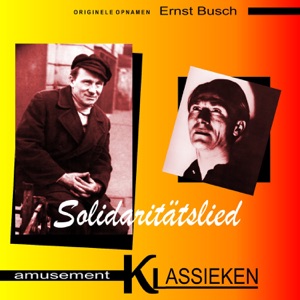 Solidaritätslied · Ernst Busch, 1932
Discography
Studio albums
- 1961Songs of the Spanish Civil War, Vol. 1: Songs of the Lincoln Brigade, Six Songs for Democracy
- 1973Hanns Eisler auf Aurora Schallplatten
- 1974Lieder
- 1981Rosen auf den Weg gestreut. Busch singt Tucholksy
- 1997Ernst Busch singt Brecht
- 2001Chronik in Liedern, Kantaten und Balladen, Volume 1: Streit und Kampf
- 2001Chronik in Liedern, Kantaten und Balladen, Volume 2: Roter Oktober
- 2001Chronik in Liedern, Kantaten und Balladen, Volume 3: Die Goldenen Zwanziger
- 2001Chronik in Liedern, Kantaten und Balladen, Volume 4: Echo von links
- 2001Chronik in Liedern, Kantaten und Balladen, Volume 5: Hoppla, wir leben
- 2001Chronik in Liedern, Kantaten und Balladen, Volume 6: Es brennt
- 2001Chronik in Liedern, Kantaten und Balladen, Volume 7: Spanien 1936 - 1939
- 2002Chronik in Liedern, Kantaten und Balladen, Volume 8: An die Nachgeborenen
- 2002Chronik in Liedern, Kantaten und Balladen, Volume 9: Ist das von gestern
- 2003Chronik in Liedern, Kantaten und Balladen, Volume 10: Zu guter Letzt
- 2005Der Rote Orpheus in Originalaufnahmen aus den dreißiger Jahren
In School of Rock
The chapters, maps and magazine stories of School of Rock are currently available in Dutch only.
- The Dream Factory: Film Reel 1NL Reader