
2 languages
Elizabeth Lutyens
From HitStory, the pop encyclopedia of School of Rock · Artist
Elizabeth Lutyens · Elisabeth Lutyens was born in London in 1906, the daughter of the famous architect Sir Edwin Lutyens and Lady Emily Bulwer-Lytton. At the age of nine she already wanted to become a composer. In 1922 she studied in Paris at the École Normale de Musique, in 1923 she travelled to India with her mother, and from 1926 to 1930 she studied at the Royal College of Music in London. She later married Edward Clark, a conductor and former BBC producer who had studied with Schoenberg. She often wrote her music in great seclusion, alongside the care of her children.
Music and breakthrough
Her success came in 1947 with a cantata on Rimbaud's poem Ô saisons, Ô châteaux. The BBC at first refused to perform it because the soprano part was supposedly too high, but was afterwards the organisation that gave the first performances of much of her work from the 1940s and 1950s. Later she wrote Quincunx for orchestra with soprano and baritone, which was premiered in 1962 at the Cheltenham Music Festival. She claimed that she had invented serialism independently before she had seen so much as a note of Webern.
Influence
To pay the bills Lutyens wrote film music for the horror films of Hammer and Amicus Productions. She was the first British woman to score a feature film, with Penny and the Pownall Case from 1948. In her film work the modern, angular music of the avant-garde can be heard, and she therefore shows that that style also found its way into the cinema in the 1960s. In 1972 her autobiography A Goldfish Bowl was published. She died in 1983.
Listening
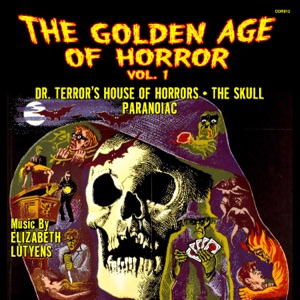 Main Title · Elizabeth Lutyens, 1963