
2 languages
David Munrow & The Early Music Consort of London
From HitStory, the pop encyclopedia of School of Rock · Artist
David Munrow & The Early Music Consort of London · The Early Music Consort of London was a British ensemble of the late 1960s and the 1970s that played medieval and Renaissance music according to historical performance practice. The musicologists Christopher Hogwood and David Munrow founded it in 1967. Munrow was inspired by the Alte Musik movement in Germany and wanted to win over the British public to music of the Middle Ages and the Renaissance. He had studied with Hogwood at Pembroke College, Cambridge.
Music and breakthrough
The group made many influential recordings. Titles include Ecco la primavera, on fourteenth-century Florentine music, from 1969, The Triumphs of Maximilian I and The Six Wives of Henry VIII from 1970, Music of the Crusades from 1971 and Music for Ferdinand and Isabella of Spain from 1972. In 1976 The Art of the Netherlands appeared as three LPs. One piece from the album Instruments of the Middle Ages and Renaissance, The Fairie Round by Anthony Holborne, was chosen by NASA for the Voyager Golden Record, which went into space in 1977 aboard Voyager 1 and 2.
Influence
The ensemble is seen as the driving force behind the British early music revival of the late twentieth century. It played the music on old instruments, in a sound that was new to many listeners. The group ceased to exist in 1976, after Munrow's death. In School of Rock, the Consort shows how the work of the fourteenth-century poet and composer Machaut sounded.
Listening
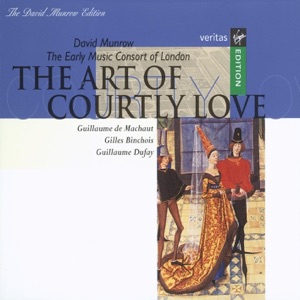 Ma fin est mon commencement (Machaut) · David Munrow & The Early Music Consort of London, 1360