 School of RockSchool of Rock
School of Rock · Mixtape 9
Electric guitar, Hammond, Mellotron, Moog, TR-808 and sampler: every new machine brought a new music with it.
Anyone who tells the history of pop music usually names singers, bands and producers. But behind every big change in pop there is also a device. Without the electric guitar, no rock 'n' roll; without the Hammond organ, no soul as we know it; without the drum machine and the sampler, no hip-hop and house.
Often such a device was built to solve a practical problem: a guitar that was not loud enough, a church that could not afford a pipe organ, a guitarist who had no bass player to practise with. Musicians then discovered that the instrument could do something other than what the manufacturer had in mind. A mistake became a sound, a flop became a genre. That is why this chapter has one central question: do musicians write the music, or do the instruments help write it?
That question is about more than technology. In pop music, sound is at least as important as melody and harmony. The chord progression of Smoke on the Water or Take On Me on paper tells you little. What you recognise is the sound: a distorted guitar, a glassy synthesizer, a deep bass drum from a machine. That sound comes largely from the instrument itself.
Side A · 1936-1972
From a guitar nobody could hear to a guitar that drowns out everything.
Track 01 · 1936-1941 · New York
In the jazz of the 1930s, the guitar had a modest role. A big band consisted of a row of saxophones, trumpets and trombones, with a rhythm section of piano, double bass, drums and guitar behind them. The guitarist played a chord on every beat. That helped the rhythm, but playing a solo made little sense: an acoustic guitar disappeared completely behind the horns. The instrument was simply too quiet.
The solution was electric. A pickup is a magnet with a coil of copper wire around it. When a steel string vibrates above that magnet, a small electric current arises in the coil that follows the vibration exactly. That current goes through a cable to an amplifier and a loudspeaker. In this way the vibration of the string becomes as loud as you like. Guitar makers experimented with it in the early 1930s, first on the lap steel, a guitar that lies flat on the lap and was used in Hawaiian music and country. In 1936 Gibson released the ES-150, a hollow jazz guitar with a pickup.
The guitarist who showed what you could do with it was Charlie Christian. He came from Oklahoma and in 1939 joined the band of Benny Goodman, at the time one of the most popular bandleaders in America. Christian played a Gibson ES-150 and did something new for a guitarist: he played long, flowing melodic lines in eighth notes, the way a saxophonist does. On Solo Flight (1941) the guitar is up front, with the orchestra behind it as accompaniment. The guitar had gone from a rhythm instrument to a solo instrument.
In the evenings after work, Christian played in jam sessions at Minton's Playhouse in Harlem. There, musicians such as Thelonious Monk, Kenny Clarke and Dizzy Gillespie experimented with faster tempos and more complicated chords. Out of those sessions grew bebop, a style covered in Mixtape 5 (Jazz Festival). Christian did not live to see it: he died of tuberculosis in 1942, aged 25.
The pattern of this first track keeps coming back in this chapter. The problem that was solved was volume. But the result was a new role: the guitarist as soloist. Twenty years later, that soloist would be the centre of rock music.
Track 02 · 1950-1958 · California, Michigan, Chicago
The hollow electric guitar had a new problem. If you turn the amplifier up loud, the hollow body starts to vibrate along with the sound from the loudspeaker. That sound goes back into the pickup, is amplified again, and within a second the guitar is howling. That ringing is called feedback. The louder you want to play, the greater the chance of it.
The solution was a guitar without a hollow space: a plank of solid wood, a solid body. It hardly vibrates along with the loudspeaker and is therefore much less prone to feedback. The guitarist and inventor Les Paul was already building a guitar around a solid block of wood in the early 1940s. In Fullerton, California, the radio repairman Leo Fender began producing a simple solid body in 1950 that would later be called the Telecaster. The Stratocaster followed in 1954, with three pickups, a rounded shape and a tremolo arm. Gibson, based in Kalamazoo, Michigan, released the Les Paul in 1952, designed in collaboration with Les Paul himself.
The solid body sounded louder and held a note longer than a hollow guitar. It was also easy to build. Fender made its guitars in a factory, from separate parts that were screwed together. The neck could be taken off with four bolts. That made the guitar cheap enough for teenagers, and they were exactly the audience that started buying the new music in the 1950s. Les Paul is also important for another reason, by the way: he was one of the first to make recordings in layers, by recording parts on top of one another. That story belongs to the studio, and the studio has itself become an instrument.
In rock 'n' roll the electric guitar became the main instrument. Chuck Berry, who recorded for the Chess label in Chicago, made the guitar riff the calling card of the new music. Johnny B. Goode (1958) does not begin with vocals, but with a guitar solo. Berry admitted that he had borrowed that intro from Carl Hogan, the guitarist of Louis Jordan. In the 1940s Jordan played jump blues, a fast, danceable forerunner of rock 'n' roll (see Mixtape 1). Berry made the lick louder, sharper and faster, and played it on an electric guitar with double strings at the same time. The song is also about a boy who plays guitar and wants to become famous with it. The guitar had become the instrument with which a teenager could dream of a different life.
That the solid body became the instrument of rock was therefore down to the sound, the price and the factory together. A saxophone was expensive and difficult. A cheap electric guitar with three chords was enough to start a band.
Track 03 · 1958-1972 · London, Montreux
An amplifier is built to make a signal bigger without changing it. If you turn it up further than it was meant for, that no longer works. The peaks of the sound wave are clipped, and the sound becomes rough, tearing and full of extra overtones. That is called overdrive or distortion. An electronic circuit that makes that effect on purpose, with a much coarser, buzzing sound, is called a fuzz. To an engineer that was a fault. For guitarists it became a choice.
That choice was first made by force. For Rumble (1958), Link Wray poked holes in the speaker of his amplifier. For You Really Got Me (1964), Dave Davies of The Kinks slashed the cone of his speaker with a razor blade. Soon after, distortion came in a little box. On (I Can't Get No) Satisfaction (1965) by The Rolling Stones, Keith Richards plays the riff through a Maestro Fuzz-Tone, one of the first effects pedals. From then on, any guitarist could choose between clean and dirty with one footswitch.
Jimi Hendrix turned all those effects into a language. He came from Seattle, played in the United States as a sideman for, among others, Little Richard, and was brought to London in 1966. There he formed The Jimi Hendrix Experience. Hendrix played a Fender Stratocaster, left-handed and turned upside down. He used feedback not as an accident but as a tone he could steer, by moving closer to the amplifier with his guitar. With the tremolo arm, the whammy bar, he made notes dive and wail. The British electronics engineer Roger Mayer built him the Octavia, a pedal that adds a tone an octave higher. You hear that sound in the solo of Purple Haze (1967). The opening chord of that song, E7#9, became so well known that guitarists now call it the Hendrix chord. At Woodstock in 1969 he played the American national anthem, in which feedback and the tremolo arm sound like falling bombs.
Distortion also has consequences for harmony. If you play a chord through a distorted amplifier, extra tones arise: difference tones, which sound at the frequency of the difference between two notes. With a fifth, such as C and G, the difference tone falls exactly an octave below the root. That sounds heavy and pure. With a third, especially in guitar tuning, difference tones arise that fall just beside the chord tones, and the chord becomes muddy and droning. That is why rock guitarists using a lot of distortion often play power chords: only the root and the fifth, without the third. A power chord is not major or minor, not happy or sad. It is simply heavy. An added advantage: you play it with two fingers and can slide it across the whole neck. Punk made grateful use of that in the 1970s.
The best-known example is Smoke on the Water by Deep Purple (1972). In December 1971 the band wanted to record an album in Montreux, on Lake Geneva. During a concert by Frank Zappa in the Montreux casino, the building burned down, and the smoke drifted across the water. The song tells that story. The riff by guitarist Ritchie Blackmore consists of two-note chords in fourths, the inversion of a fifth. It is so simple that almost every beginning guitarist learns it, and it only works well with distortion. Out of this sound grew hard rock and heavy metal: music built on what the distorted guitar does well.
Side B · 1935-1986
A church organ for the pub, a tape player with keys and a cabinet full of cables: keyboards change the sound of the group.
Track 01 · 1935-1967 · Chicago, Memphis, London
A pipe organ is big, expensive and hard to move. In 1935 in Chicago, the American inventor Laurens Hammond built an electric alternative, intended for churches that could not afford a pipe organ. In a Hammond organ, small metal discs with a wavy edge, the tonewheels, spin past a small magnet. Just as with a guitar pickup, this produces an electric current, and each disc supplies one pure tone.
The special thing is the drawbars: sliders above the keys with which you mix in overtones. A note does not sound only at its own pitch; higher tones always sound along with it and determine the tone colour. With the drawbars you choose for yourself how much of each overtone you hear: an octave higher, a fifth above that, another octave higher. In this way you build a sound from separate tones. That principle is called additive synthesis, and the Hammond was doing it decades before the word synthesizer existed.
The sound we now associate with the Hammond organ comes largely from another cabinet: the Leslie speaker, devised by Don Leslie. In it, a horn for the high tones and a drum for the low tones rotate. Because the sound keeps moving towards you and away from you again, the pitch wavers slightly up and down and the volume swells and fades. The organ gets a floating, undulating sound. The organist can switch the speed from slow to fast while playing. At first Hammond wanted nothing to do with the Leslie, but organists bought them anyway. The most widely used model became the Hammond B-3, built from 1954.
The organ that was meant for the church ended up in jazz clubs and bars in the 1950s. Jimmy Smith made the Hammond a jazz instrument: with his left hand and feet he played the bass line, with his right hand the solo. In soul, the organ became a fixed part of the band. Booker T. & the M.G.'s were the house band of the Stax label in Memphis and played on records by, among others, Otis Redding. In 1962 they recorded Green Onions. Booker T. Jones was seventeen. The organ plays the blues riff and the melody, Steve Cropper's guitar plays short stabs and, halfway through, a sharp solo. Here the Hammond is not background, but the band's second guitar sound.
In the English rock of the 1960s, the organ sounded solemn, as in a church. A Whiter Shade of Pale by Procol Harum (1967) opens with a Hammond melody by organist Matthew Fisher. That melody refers to Bach: to his Air and to the cantata Wachet auf. The Leslie gives the long notes their wavering. The single became an enormous hit in 1967. Fisher was not credited as a composer at the time; the music was attributed to singer Gary Brooker. Fisher felt that his organ part was a composition of its own and went to court much later. In 2009 he was recognised as co-author. That court case shows how important a sound and an instrumental part can be in pop music: without that organ it is a different song.
In hard rock, too, the Hammond kept a place. Jon Lord of Deep Purple, the band of Smoke on the Water, played his Hammond through amplifiers that sounded just as loud and distorted as Blackmore's guitar.
Track 02 · 1963-1971 · Birmingham, Los Angeles
An orchestra in the studio is expensive. Taking an orchestra on tour is almost impossible for a pop group. The Mellotron, built from 1963 in Birmingham, England, solved that in a striking way. Under each key sits a strip of recording tape with a recording of a real instrument: a violin, a flute, a choir. If you press the key, the tape runs past a playback head and you hear that recording at the pitch of that key. When you let go, a spring pulls the tape back to the start.
That principle has limitations. A note lasts a maximum of about eight seconds, then the tape runs out. The tapes never run quite evenly, so the pitch wavers slightly. The instrument is sensitive to heat and knocks. But it was precisely those slightly wobbly, unreal strings that became a sound of their own. The Mellotron is in effect the forerunner of the sampler, twenty years before the word existed: a recorded sound under a key.
The Beatles used the Mellotron in 1966 for the intro of Strawberry Fields Forever: the flutes you hear are tapes under the keys, played by Paul McCartney (see Mixtape 3). Mike Pinder of The Moody Blues made the Mellotron the heart of the group's sound. In Nights in White Satin (1967) the floating strings are not an orchestra, but a Mellotron. After that the instrument became the sound of prog rock. In 1969 King Crimson filled their debut album with walls of Mellotron choirs and strings.
The Fender Rhodes solves a different problem. An ordinary piano is heavy and has to be tuned after every transport. Harold Rhodes developed an electric piano without strings. When you strike a key, a small hammer hits a thin metal rod, and a pickup turns that vibration into current, just as with a guitar. The sound is warm and softly bell-like. The harder you strike, the more the sound growls. The instrument was brought to market together with Fender.
Ray Manzarek of The Doors played the Rhodes on Riders on the Storm (1971), the last song on the last album the band made with Jim Morrison. The soft Rhodes part and the sound of rain and thunder, taken from a sound-effects record, give the song its dark, brooding atmosphere. The Doors had no permanent bass player; on stage, Manzarek played the bass lines with his left hand on a separate bass version of the instrument.
In jazz the Rhodes became popular when Miles Davis asked his pianists to play electric in the late 1960s. After that the instrument became a fixed part of jazz rock and soul, and in the late 1990s of neo-soul, in which the warm, slightly distorted sound resurfaced. Anyone who now opens a plug-in called 'E-piano' in a DAW usually gets an imitation Rhodes.
Track 03 · 1964-1976 · Trumansburg, London, Paris
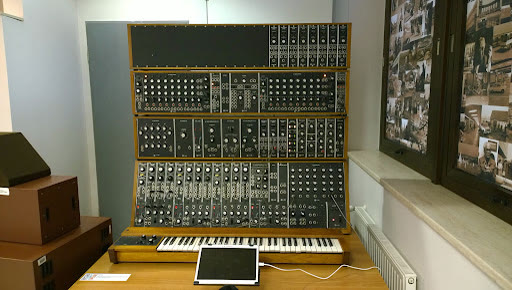
The instruments so far made their sound with something mechanical: a string, a spinning disc, a tape, a metal rod. The synthesizer makes sound entirely electronically. In Mixtape 8 (Electronic music), Robert Moog already came past as the man who brought the synthesizer to pop music. Here the question is how such an instrument actually works, because that way of working determines how synthesizer music sounds.
From 1964, Robert Moog built synthesizers from separate modules in Trumansburg, in the state of New York. Each module does one thing. An oscillator generates a tone, in the form of a wave: a round sine, a sharp sawtooth or a hollow square wave. A filter removes some of the overtones from that wave, so that the sound becomes duller or, conversely, brighter. An envelope determines how a note develops over time: how fast it starts, how long it lasts and how fast it dies away. You connected those modules with cords, the patch cables. That is why a set-up sound on a synthesizer is still called a patch. The modules controlled one another with electric voltage: a higher voltage meant a higher note or a more open filter.
This way of working is called subtractive synthesis. You start with a rich wave full of overtones, such as a sawtooth, and filter away what you do not want. It can be compared to sculpting: you chip away until the shape remains. The opposite principle, building a sound from separate tones, you already saw with the drawbars of the Hammond organ. The characteristic sound of the Moog lies mainly in the filter. If you open it slowly, you hear a note that 'opens up' from dull to bright.
The Moog became known to the general public through Switched-On Bach (1968) by Wendy Carlos, one of the best-selling classical records ever. Carlos recorded music by Bach part by part, because the synthesizer could only play one note at a time. In rock the synthesizer became a solo instrument, just like the electric guitar before it. Keith Emerson, keyboard player of the British band Emerson, Lake & Palmer, used the Moog for long, virtuoso solos. On Lucky Man (1970) the song begins as a simple acoustic ballad. Only at the end does the Moog come in, with a solo that glides and squeals and was recorded in one take. Thanks to the Minimoog of 1970, a small version without cords that you could take to a gig, the synthesizer became an ordinary band instrument.
Jean-Michel Jarre chose a different path. He used synthesizers not for solos but to build entire soundscapes. He recorded Oxygène (1976) in an improvised studio in his kitchen in Paris, with a few synthesizers and a tape recorder. Without an orchestra or band it sounds like a complete composition. Jarre's story is told at greater length in Mixtape 8. Here it is enough to see what happened between 1964 and 1976: an instrument that began as a cabinet full of cables in a laboratory could now be used by one person at home to make an album that sold all over the world.
Track 04 · 1979-1986 · Tokyo, Sydney, Oslo
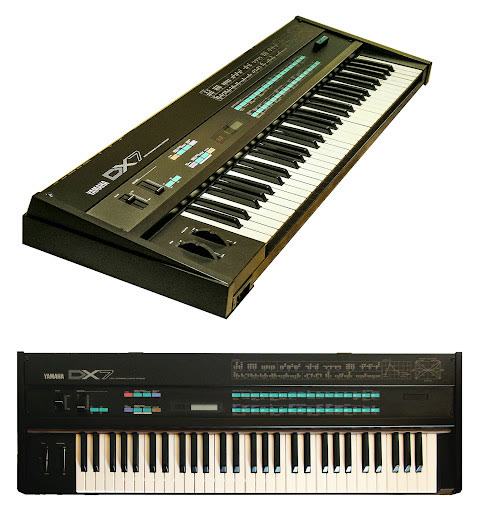
In the 1980s the synthesizer went digital, and with that the sound of pop music changed again (see also Mixtape 7, The 1980s). The most important machine was the Yamaha DX7 of 1983. It did not work with filters like the Moog, but with FM synthesis: frequency modulation. In it, one wave makes the frequency of another wave go up and down very fast. This creates new overtones that were not in the original waves. The principle was developed by John Chowning at Stanford University; Yamaha obtained a licence for it.
The sound of FM is bright, glassy and metallic. It is good at chimes, bells, electric pianos and sharp basses, and less good at the warm, round sound of an analogue synthesizer. The DX7 was also affordable, light and reliable, and it became one of the best-selling synthesizers ever. Programming a sound on the DX7 was complicated, with small buttons and a small screen. That is why many musicians simply used the factory sounds. The electric piano from the presets in particular can be heard on countless ballads of the 1980s. In this way a factory setting from Yamaha determined the sound of a decade.
In that same year, 1983, an agreement was reached that was perhaps more important than any synthesizer: MIDI, Musical Instrument Digital Interface. Until then, a synthesizer from one brand could not communicate with one from another brand. MIDI is a shared standard with which instruments and computers tell one another which note is being played, how loud and how long. With one keyboard you can play five synthesizers at once, or have a computer play back the notes. MIDI was devised by Dave Smith of Sequential and Ikutaro Kakehashi of Roland. In 2013 they were jointly awarded a technical Grammy for it. The standard is still in use: every DAW works with it.
A third innovation was the sampler. The Fairlight CMI from Australia (1979) could record a real sound digitally and put it under the keys, at any pitch. The idea of the Mellotron now worked without tapes. The Fairlight was so expensive that only stars could afford it; Peter Gabriel and Kate Bush were among the first. The Emulator from the American company E-mu was cheaper. With these machines sampling arrived, and on side C that would change pop music again.
Take On Me by the Norwegian a-ha (1985) shows how far the synthesizer had come in twenty years. The riff is a sharp synthesizer sound, the bass line comes from a sequencer and the drums from a machine. A guitar is almost superfluous. Where in 1972 Hot Butter still put a synthesizer on top of an ordinary band (see Mixtape 8), here the synthesizer has itself become the band.
Side C · 1980-2008
Drum machines, bass line machines, samplers and Auto-Tune: what was once a flop or a correction tool became a genre.
Track 01 · 1980-2008 · Tokyo, Ostend, Atlanta
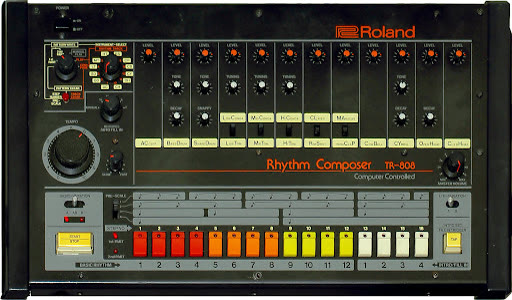
The Roland TR-808 came onto the market in 1980. It was intended as a practice device and as an aid for musicians who wanted to replace a drummer when making demos. With a row of coloured buttons you programme a pattern of sixteen steps; the machine plays it endlessly. In Mixtape 8 we already saw how the 808 ended up in electro, via Planet Rock. Here it is about the machine itself, and why this particular device lasted so long.
The 808 does not use recordings of real drums. Every sound is generated electronically with circuits that imitate a drum. The result does not sound like a drum kit. The snare drum is a short, dry crack, the hi-hat a metallic ticking, the handclap an artificial clapping. Musicians thought it sounded fake, and the machine flopped. Roland stopped production after a few years. But that made it cheap second-hand, and it ended up with young producers without a budget.
The most important part is the bass drum. On the 808 you can let the bass drum ring out long, as a low, round tone that slowly dies away. On a large sound system you feel that tone before you hear it: a deep sub-bass. Producers discovered that you could also tune that bass drum and make it sound at different pitches. Then it is no longer a drum, but a bass instrument.
One of the first hits with an 808 came not from hip-hop, but from soul. Marvin Gaye recorded Sexual Healing (1982) during a period in which he was living in Ostend in Belgium. The rhythm is strikingly bare: a few ticks, a clap and a bass drum, with Gaye's soft, multi-layered vocals over the top. It is a machine with soul, and proof that a drum machine does not have to sound cold.
After that the 808 found its way into almost every genre of Black American dance music. In electro and early hip-hop it sounded in New York; in Miami bass the bass drum was set as low and loud as possible for cars with big speakers. In Atlanta, from the 2000s, trap grew, in which long, gliding 808 bass drums and fast hi-hat rolls form the basis. The word '808' in hip-hop now simply means: a deep, long-ringing bass, even when it no longer comes from the Roland device.
Kanye West named his 2008 album after the machine: 808s & Heartbreak. On Love Lockdown the 808 bass drum is no longer a rhythm, but a melody. West's voice runs through Auto-Tune, the effect with which this chapter ends. In this way two machines from side C come together in one song.
Track 02 · 1981-1992 · Tokyo, Chicago, Germany
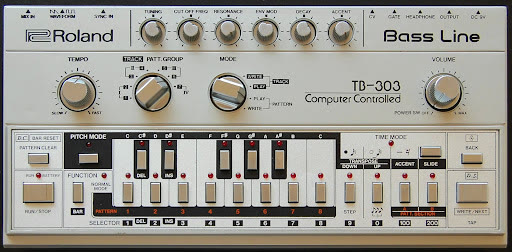
The Roland TB-303 Bass Line appeared in the early 1980s as a companion to Roland's drum machines. The idea was simple. A guitarist practising alone at home had no bass player. The little silver box could play a bass line that you programmed in advance, note by note. The device has a simple synthesizer with one oscillator and a filter, and a built-in sequencer. For each note you can give an accent, which makes that note a bit louder and sharper, or a slide, in which the note glides to the next.
This machine flopped too. The TB-303 did not sound like a bass guitar, programming was cumbersome, and in 1984 it went out of production. As with the 808, it then ended up second-hand and cheap with producers who did something other than what was intended with it.
Producers in Chicago discovered that the most interesting part of the 303 was not the notes, but the two knobs of the filter: cutoff and resonance. With cutoff you determine how many overtones come through; with resonance you boost the tones around that point, so that the filter starts to squeal and whistle. By turning those knobs while playing, the same bass line constantly changes its sound: dull and droning, then shrill, squelching and wailing. This is how the group Phuture made Acid Tracks in 1987, which is considered the first real acid track, as described in Mixtape 8. The squealing, squelching sound got a name: acid.
In 1992 the German duo Hardfloor made Acperience 1, a track of almost nine minutes that revolves almost entirely around one 303 bass line. Little happens harmonically. What changes is the sound: the filter opens and closes, the resonance builds up, the line becomes sharper and then softer again. Anyone who listens to it hears that the instrument here is not the keys or the notes, but the filter knob. The musician does not play a melody, he plays tone colour.
That is the reversal this chapter is about. Roland built the 303 to imitate a bass player. The producers in Chicago and Europe used it precisely because it did not sound like a bass player. By now the 303 is so sought after that there are countless clones and plug-ins of it, and an original second-hand one costs many times what it cost new.
Track 03 · 1987-2007 · London, New York, Detroit
Hip-hop began with two turntables. In the Bronx in the 1970s, DJs discovered that the audience danced hardest to the break: the part of a funk record where only the drums play. By using two copies of the same record, they could repeat that break endlessly. The sampler turned that technique into an instrument.
With the E-mu SP-1200 (1987) and the Akai MPC (1988), a producer could record a piece of a record, cut it into pieces and put those pieces on rubber pads. By tapping the pads you play the pieces back, like a drum kit of samples. The MPC was designed together with Roger Linn, who had earlier built the LinnDrum, and had a built-in sequencer. A producer could make a complete beat with it without any other device. Hip-hop thus became a collage: drums from one funk record, a horn stab from another, a bass line from a third. A few seconds of drums by James Brown, such as the break of Funky Drummer, became the basis of hundreds of songs. How that shaped hip-hop is told in Mixtape 6 (Fear of a Black Planet).
In England, Pump Up the Volume by M|A|R|R|S became a number 1 hit in 1987. M|A|R|R|S was a one-off collaboration between two groups from the London label 4AD. The song consists almost entirely of samples: the title phrase comes from Eric B. & Rakim, there are bits of James Brown in it, and a singer from Israel. That led to one of the first big court cases about samples. Producers whose work had been used demanded their share. Since the early 1990s, a sample has had to be cleared with the owner of the recording and of the composition. That is called sample clearance. For well-known samples that can be so expensive that producers would rather replay a part or record their own sounds.
The sampler also changed the idea of timing. A sequencer can automatically straighten notes onto the beat. That is called quantize. The producer J Dilla from Detroit programmed his MPC without quantize. He played the pads in by hand, so that the bass drum sometimes comes a fraction too early and the snare a fraction too late. His beats therefore swing a little 'drunkenly', and that way of playing was imitated by a whole generation of producers and drummers. His MPC is now in the Smithsonian, the national museum of the United States in Washington.
Sampling is a chain. Kanye West built Stronger (2007) on Harder, Better, Faster, Stronger by Daft Punk from 2001. For that song Daft Punk had itself sampled a piece from an older funk record. A song can thus contain three generations of music. Anyone who asks this chapter's question, who writes the music, gets an extra layer with the sampler: here the old records help write it.
Track 04 · 1998 · London
Auto-Tune was devised by Andy Hildebrand, an American engineer who had previously worked for the oil industry, where he used sound waves to investigate what lay underground. With the same mathematics he could measure the pitch of a voice. The software he released in 1997 corrects wrong notes: if someone sings a little flat, Auto-Tune imperceptibly moves the note to the right pitch. It was meant to be inaudible. A studio could thus save a recording without having the singer sing again.
When Believe by Cher (1998) was recorded, the British producers did something the maker had not intended. Auto-Tune has a setting that determines how fast the correction happens. Normally it is set so that a voice glides calmly to the right note. The producers set the speed to zero. As a result the voice jumps from one note to the next without a transition, with an audible kink in between. Listen to the line "I can't break through": the voice sounds as if it is stepping through a machine. For a long time the producers insisted that it was a vocoder, to keep the trick secret. Believe became a worldwide hit, and from then on the sound was called the Cher effect.
What was meant to hide became a recognisable sound. In the 2000s the American singer T-Pain made Auto-Tune his trademark. Kanye West used it on 808s & Heartbreak to express sadness and loneliness: the mechanical voice sounds as if someone cannot quite show his emotion. In trap and hip-hop after that, it became an ordinary part of the voice. For many young rappers, Auto-Tune is not a correction but a way of singing. They deliberately let the voice glide and break, just as Hendrix made his guitar wail with the tremolo arm.
That brings us full circle. The electric guitar was built to sound louder and became a solo instrument. Distortion was a fault and became a genre. The 808 and the 303 were failed practice devices and became the basis of hip-hop, house and techno. Auto-Tune was supposed to correct inaudibly and became the sound of a generation. Time and again a manufacturer devised an instrument, and time and again musicians discovered what it could do. Does the instrument help write? In all these examples, the machine determined which sounds were possible. What happened with those sounds was decided by the musicians. Now the same question applies to the laptop, the DAW, sample libraries and voices made by AI.
All the songs from this chapter, in the order of the text. Scan the code with your phone.
open.spotify.com/playlist/6nbbhf5CoUiKs4WHz6v0th