
2 languages
Fanfare Ciocărlia
From HitStory, the pop encyclopedia of School of Rock · Artist
Fanfare Ciocărlia is a Roma brass band from Zece Prăjini, a village in north-eastern Romania inhabited exclusively by Roma families. There making music is a family tradition. The men work as farmers or in a nearby factory and play at weddings and christening parties. In 1996 the German sound engineer Henry Ernst travelled to the region to look for village musicians. There he found a brass band led by the clarinettist Ioan Ivancea.
Music and breakthrough
Ernst and his colleague Neumann recorded the group in Bucharest in 1997. The debut album Radio Pașcani appeared in 1998 on the Berlin label Piranha Musik and was an instant hit. Baro Biao in 1999 and Iag Bari in 2001 followed, and the group toured Europe, the United States, Japan and Australia. Later came, among others, Gili Garabdi in 2005 and Balkan Brass Battle in 2011, an album on which the band took on a Serbian brass band. In 2012 it played at the Nobel Peace Prize ceremony in Oslo.
Influence
The sound consists of trumpets, tubas, clarinets, saxophones and percussion. The music is lightning-fast and has complex rhythms, with staccato solos from the brass. The sources are Roma and Romanian folk dances, supplemented with Turkish, Bulgarian and Serbian influences. Fanfare Ciocărlia brought Balkan brass to clubs and festivals, to an audience that appreciated rock, rave and world music alike.
Listening
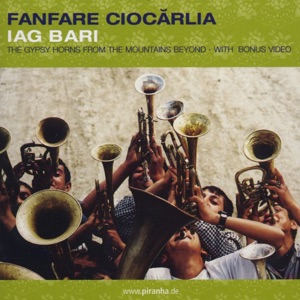 Iag Bari · Fanfare Ciocărlia, 2001
Discography
Studio albums
- 1998Radio Pașcani
- 1999Baro Biao: World Wide Wedding
- 2001Iag Bari: The Gypsy Horns From the Mountains Beyond
- 2005Gili Garabdi: Ancient Secrets of Gypsy Brass
- 2007Queens and Kings
- 2011Balkan Brass Battle
- 2014Devil’s Tale
- 2016Onwards to Mars!
- 2021It Wasn't Hard To Love You
- 2025The Devil Rides Again
Mentioned in other articles
- Balkan brass Genre
Boban Marković from Serbia and the Romanian Fanfare Ciocărlia brought the sound to stages all over the world.