
2 languages
Ralph Vaughan Williams
From HitStory, the pop encyclopedia of School of Rock · Artist
Ralph Vaughan Williams was nearly seventy when he wrote his first film music. In 1940 the conductor Muir Mathieson persuaded him to contribute to 49th Parallel (1941), a war film by Michael Powell. Documentaries followed, among other things, and The Story of a Flemish Farm (1943). His best-known film work is Scott of the Antarctic (1948). For it he used a wordless soprano, women's chorus, organ and a wind machine to depict the icy expanse. He later reworked that music into his Sinfonia antartica (1952). His film style is the same as in his symphonies: modal harmony, folk-song-like melodies and a broad string sound.
Listening
 Prelude · BBC Philharmonic & Rumon Gamba, 1941
 The Flag Flutters in the Wind · BBC Philharmonic & Rumon Gamba, 1943
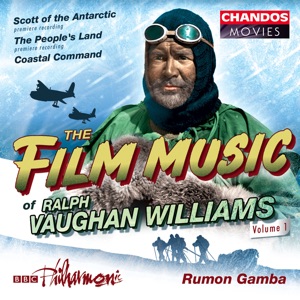 Scott of the Antarctic: Main Titles · BBC Philharmonic & Rumon Gamba, 1948
Works
- 194149th Parallel
- 1948Scott of the Antarctic
In School of Rock
The chapters, maps and magazine stories of School of Rock are currently available in Dutch only.
- Film Music MapNL Map
- The Dream Factory: Film Reel 3NL Reader
Mentioned in other articles
- British concert composers (Denham and Ealing) Genre
Ralph Vaughan Williams later used his score for Scott of the Antarctic (1948) for his Sinfonia antartica.