
2 languages
Jacopo Peri
From HitStory, the pop encyclopedia of School of Rock · Artist
Jacopo Peri was an Italian composer, singer and instrumentalist of the late Renaissance and early Baroque. He was born in 1561 in Rome or Florence and died in 1633. He sang in churches in Florence, including in the monastery of Santissima Annunziata, and from 1588 worked at the Medici court, first as a tenor and keyboard player and later as a composer. His nickname was Il Zazzerino, the blond.
Music and breakthrough
In the 1590s he joined Jacopo Corsi, an important patron of music. They wanted to bring Greek tragedy back to life, and built on the experiments of the Florentine Camerata with monody: solo singing above a basso continuo. With the poet Ottavio Rinuccini, Peri made Dafne around 1597, the first work in a new form, opera. It has largely been lost.
Influence
His second opera, Euridice, was first performed on 6 October 1600 in the Palazzo Pitti, at the wedding of Maria de' Medici and Henry IV of France. This is the oldest opera that has survived. The work uses recitatives that move the action along between the arias and choruses. The singer tells the story in a speech-like singing style, just above a simple accompaniment. Peri wrote more operas, including La Flora with Marco da Gagliano, but his style was already considered old-fashioned at his death. Even so he is important as the man who began music theatre with song and story.
Listening
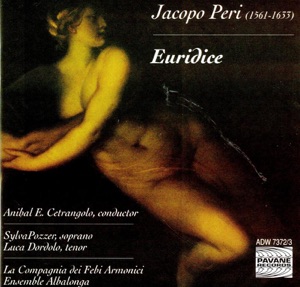 Euridice: Funeste piagge (Ensemble Albalonga) · Jacopo Peri, 1600
Discography
Studio albums
- 1997Le musiche sopra L'Euridice di Ottavio Rinuccini rappresentantate nello Sponsalizio della Cristianissima Maria de' Medici Regina di Francia e di Navarra (1600)
- 2000Euridice
- 2001Italian Renaissance Dances Vol. 1
- ?Il Zazzerino - Music of Jacopo Peri
Mentioned in other articles
- Early opera Genre
This is how opera arose: Jacopo Peri's Euridice sounded in 1600 in the Palazzo Pitti at a princely wedding.